













-
原子核质量是反映核结构与稳定性的重要物理量, 在核结构研究与天体核物理过程中均具有关键作用. 目前, 基于神经网络的研究多集中于结合能或中子、质子分离能的单一预测, 较少关注结合能与分离能之间的物理约束关系. 本研究基于相对论平均场点耦合模型 PCF-PK1, 结合神经网络对原子核结合能以及单、双中子和单、双质子分离能进行了系统预测. 在训练过程中引入分离能约束, 以保持结合能与分离能之间的物理自洽性. 结果表明, 神经网络能够显著提升结合能的整体预测精度. 其中, 在特定损失函数权重组合下, 结合能的预测均方根偏差可达到 0.140 MeV. 进一步分析发现, 在保持物理自洽性的前提下, 引入分离能约束能够同时对结合能和分离能的预测结果实现小幅优化. 本文数据集可在
https://doi.org/10.57760/sciencedb.j00213.00239 中访问获取.Nuclear masses are fundamental observables that reflect nuclear structure and stability, playing a key role in nuclear physics and astrophysical processes. Most existing neural network studies focus on predicting either binding energies or neutron/proton separation energies individually, with limited attention to the physical correlations between these observables. Based on the relativistic point-coupling model PCF-PK1, a physics-informed artificial neural network (ANN) was developed to systematically predict nuclear binding energies along with single- and double-neutron/proton separation energies, while preserving the physical self-consistency of the predictions. To assess the impact of incorporating separation-energy constraints, networks were trained with varying loss function weight combinations, enabling a comparison between networks without separation-energy constraints (e.g., ANN1) and those including such constraints (e.g., ANN3). The neural network significantly improves the overall prediction accuracy of binding energies compared with the PCF-PK1 model. Without separation-energy constraints, ANN1 already achieves high precision for binding energies (RMSE $\approx$ 0.147 MeV) and separation energies (RMSE $\approx$ 0.158–0.185 MeV). Incorporating separation-energy constraints in ANN3 results in a slight improvement in overall prediction accuracy. The binding energy predictions improve by approximately 4.6%, while the separation energy predictions increase by 8.9–12.0%. The improvement is particularly noticeable for nuclei where the deviations of ANN1 predictions from experimental values exceed 0.2 MeV. Supporting datasets are publicly accessible at the Science Data Bank ( https://doi.org/10.57760/sciencedb.j00213.00239 ).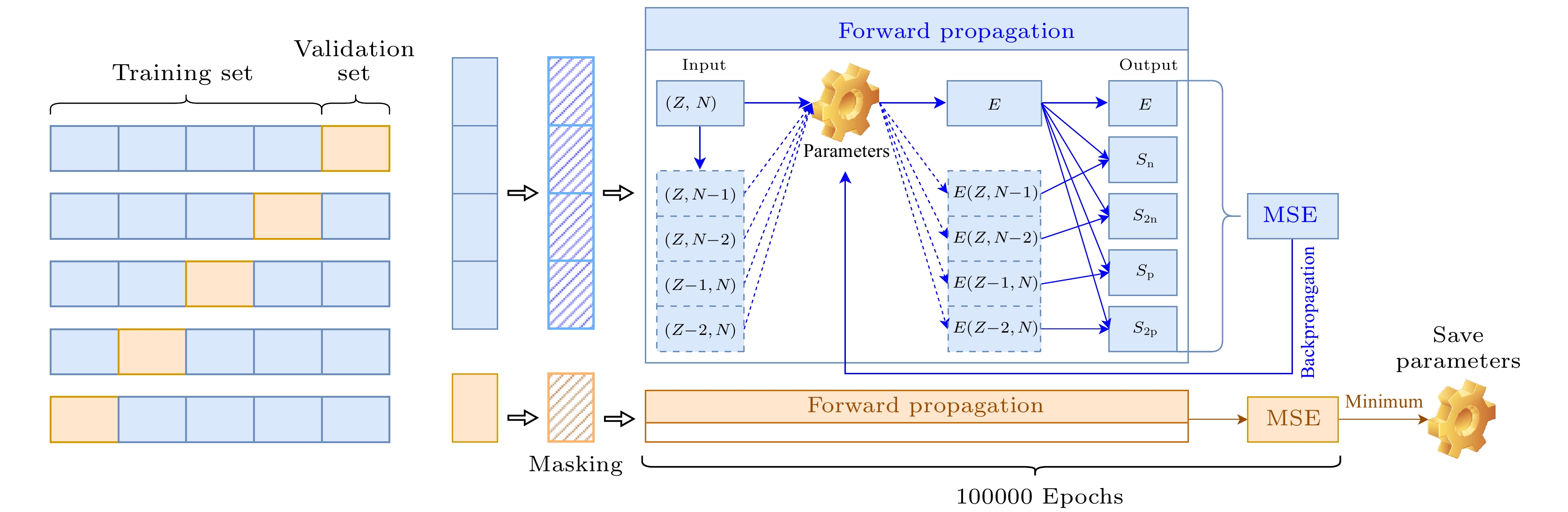
-
Keywords:
- nuclear mass /
- neural network /
- separation energy
-
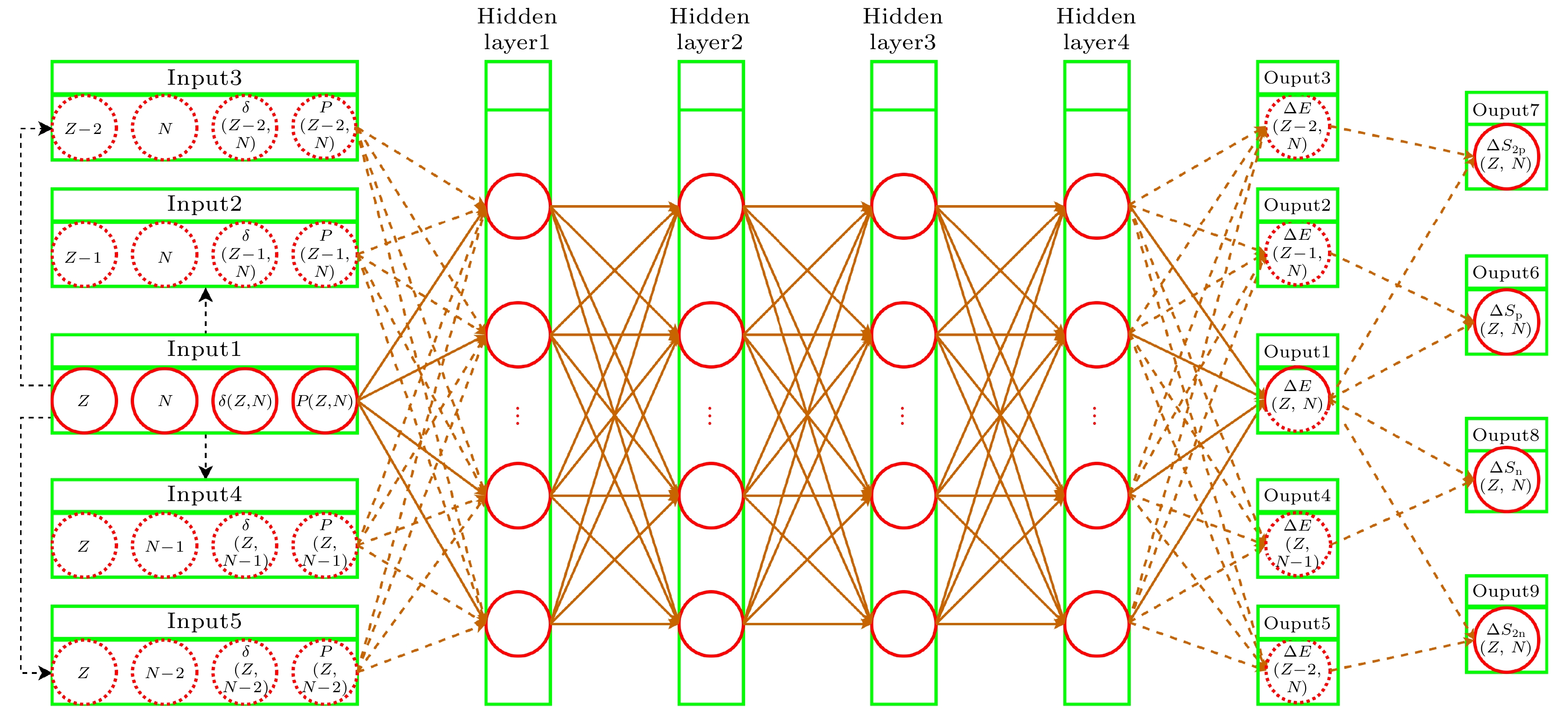
图 1 引入分离能约束的多层前馈神经网络结构示意图
Fig. 1. Diagram of the feedforward neural network with separation energy constraints.
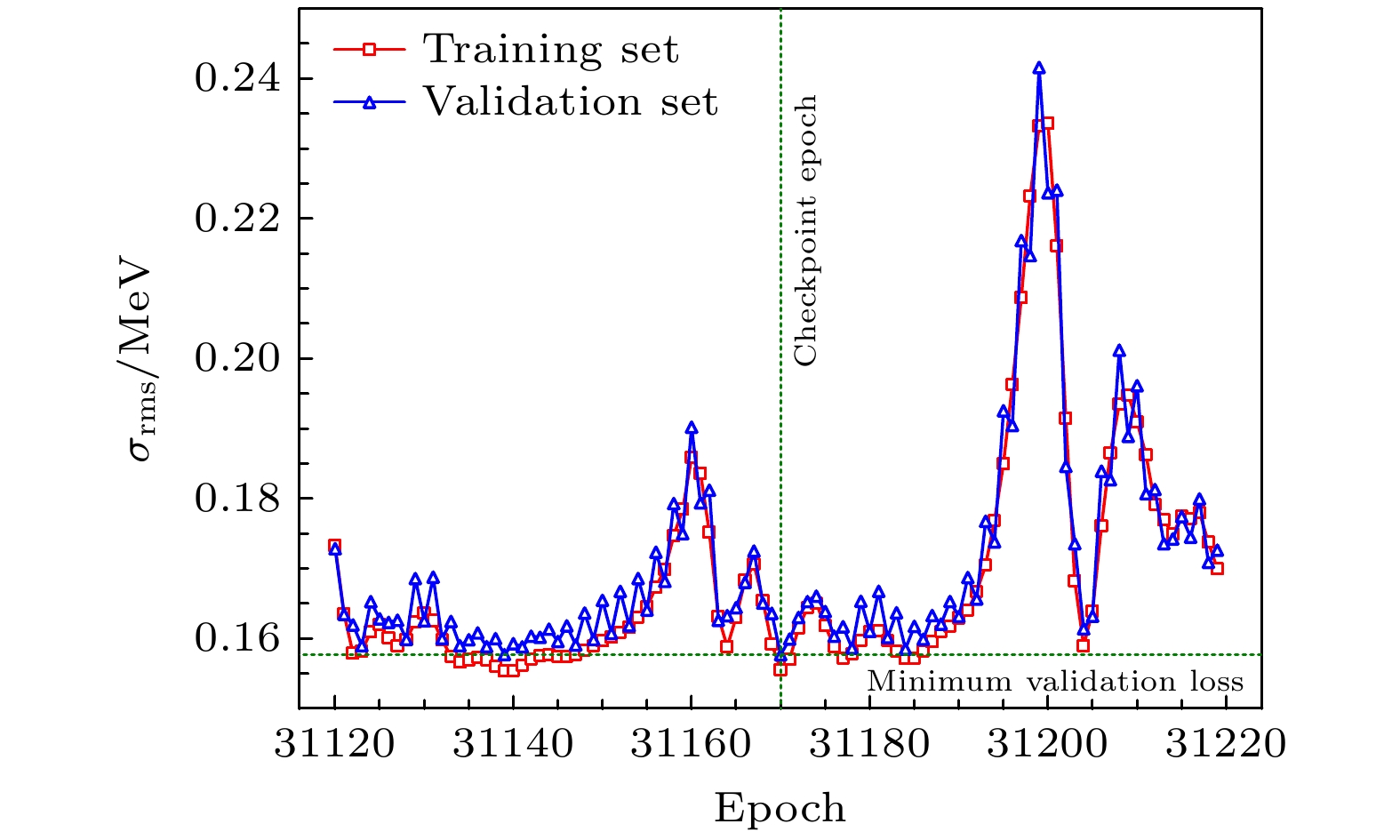
图 2 训练过程中训练集(红色)与验证集(蓝色)均方根偏差随训练步数的变化示意. 当验证集偏差达到最小值时, 模型参数被保存
Fig. 2. Root-mean-square deviations of training (red) and validation (blue) sets over epochs; parameters at minimum validation deviation are saved.
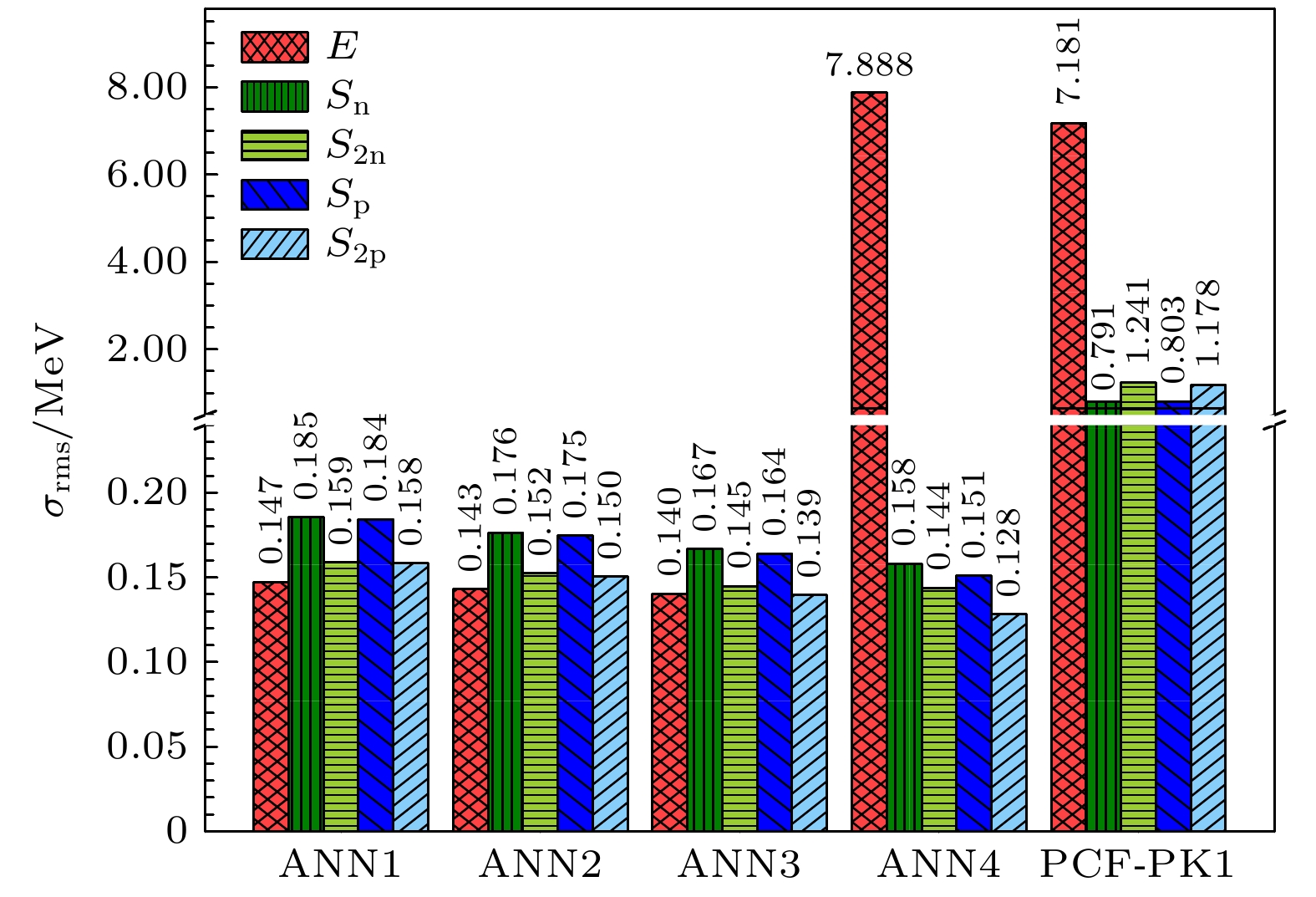
图 3 ANN1、ANN2、ANN3、ANN4以及PCF-PK1模型对原子核E、$ S_{\mathrm{n}} $、$ S_{\mathrm{2 n}} $、$ S_{\mathrm{p}} $和$ S_{\mathrm{2 p}} $的预测值与AME2020实验值均方根偏差的对比
Fig. 3. Comparison of RMSE between ANN1, ANN2, ANN3, ANN4, and PCF-PK1 predictions and AME2020 experimental values for E, $ S_{\mathrm{n}} $, $ S_{\mathrm{2 n}} $, $ S_{\mathrm{p}} $, and $ S_{\mathrm{2 p}} $.
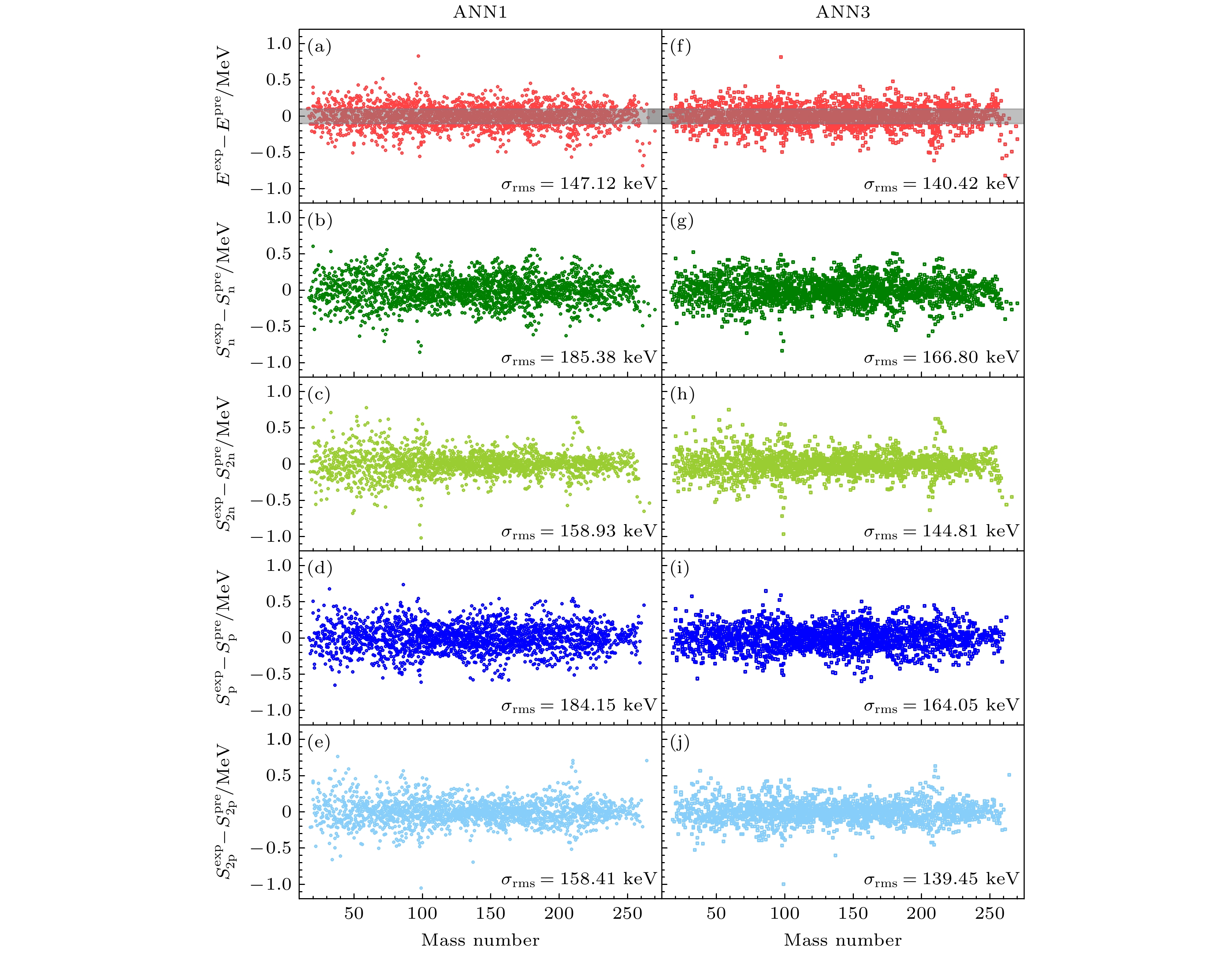
图 4 ANN1和ANN3预测值相对于实验值的偏差随核质量数的变化, 包括结合能E(a, f); 单、双中子分离能$ S_\mathrm{n} $(b, g)、$ S_\mathrm{2 n} $(c, h) 以及单、双质子分离能$ S_\mathrm{p} $(d, i)、$ S_\mathrm{2 p} $(e, j). 其中(a—e)为ANN1预测结果, (f—j)为ANN3预测结果, 阴影区域对应结合能预测值与实验值偏差的$ \pm $0.1 MeV范围
Fig. 4. Deviations of ANN1 and ANN3 predictions from experimental values as a function of nuclear mass number, including binding energy E(a, f), single- and double-neutron separation energies $ S_\mathrm{n} $(b, g) and $ S_\mathrm{2 n} $(c, h), and single- and double-proton separation energies $ S_\mathrm{p} $(d, i) and $ S_\mathrm{2 p} $(e, j). Panels (a–e) show ANN1 predictions, and panels (f–j) show ANN3 predictions. The shaded areas indicate $ \pm $0.1 MeV deviations of binding energies.
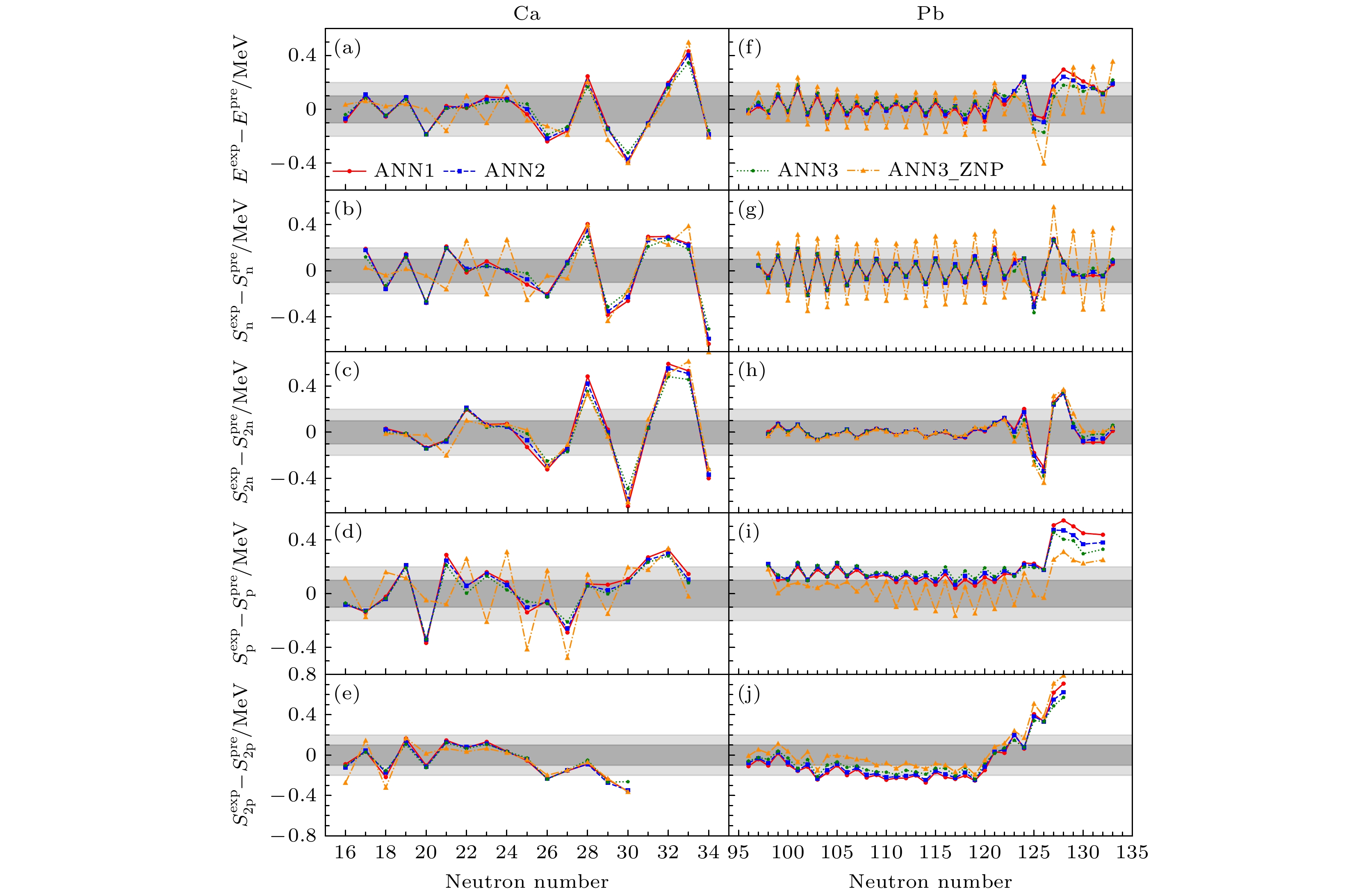
图 5 ANN1(红色实线)、ANN2(蓝色虚线)、ANN3(绿色点线)和ANN3_ZNP(橙色点划线)对Ca($ Z=20 $)及Pb($ Z=82 $)同位素链结合能E(a, f)、单中子分离能$ S_{\mathrm{n}} $(b, g)、双中子分离能$ S_{\mathrm{2 n}} $(c, h)、单质子分离能$ S_{\mathrm{p}} $(d, i)以及双质子分离能$ S_{\mathrm{2 p}} $(e, j)的预测值与实验值偏差. 图中深浅不同的阴影分别对应预测值与实验值偏差在$ \pm $0.1 MeV和$ \pm $0.2 MeV的区间
Fig. 5. Deviations between the predictions and experimental values of the binding energy E(a, f), single- and double-neutron separation energies $ S_{\mathrm{n}} $, $ S_{\mathrm{2 n}} $(b, g, c, h), single- and double-proton separation energies $ S_{\mathrm{p}} $, $ S_{\mathrm{2 p}} $(d, i, e, j), obtained with ANN1 (red solid line), ANN2 (blue dashed line), ANN3 (green dotted line), and ANN3_ZNP (orange dash-dot line) for the Ca($ Z=20 $) and Pb($ Z=82 $) isotopic chains. Dark and light shaded areas represent deviations from experimental values of $ \pm $0.1 MeV and $ \pm $0.2 MeV, respectively.
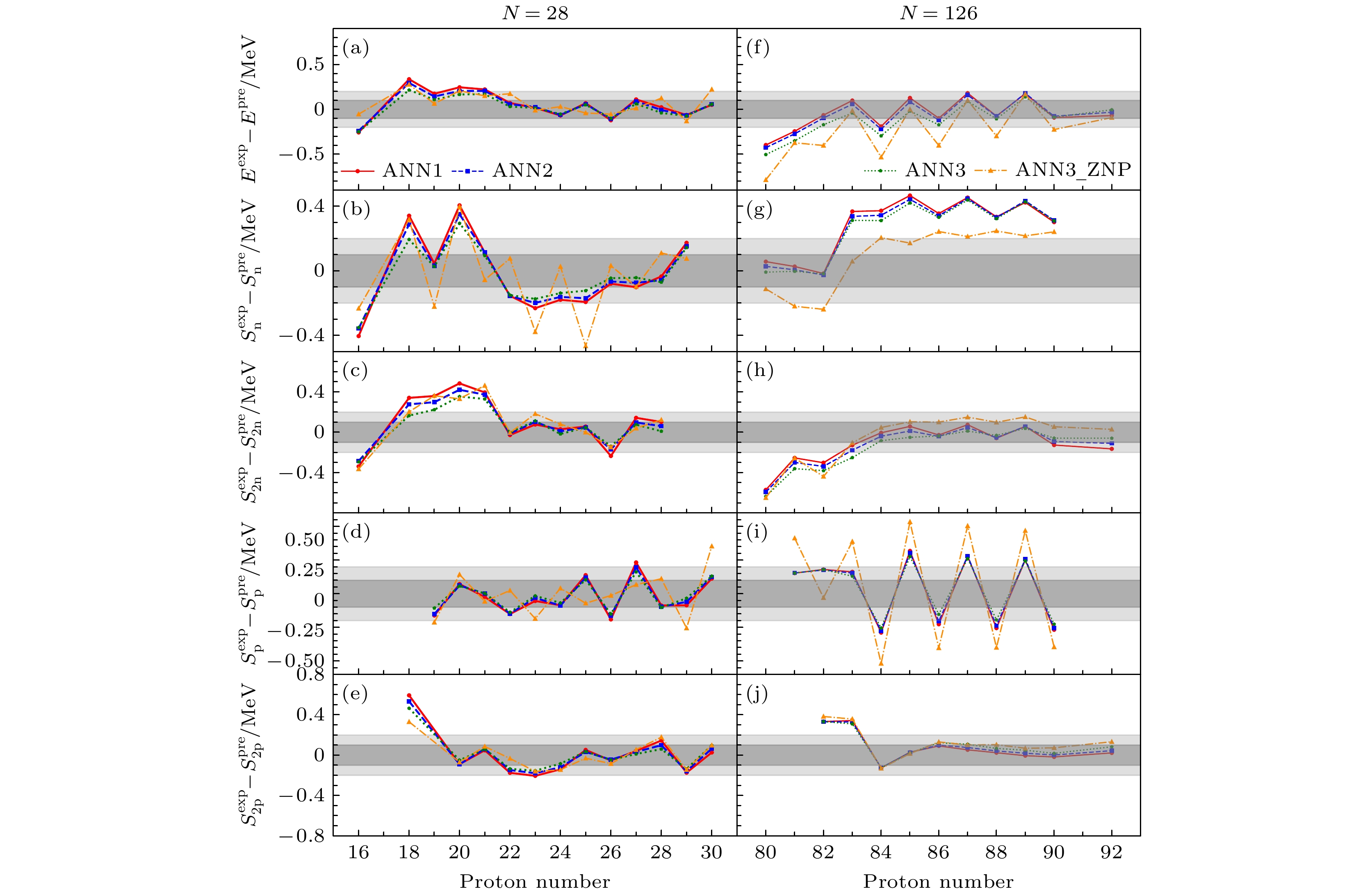
图 6 同图4, ANN1(红色实线)、ANN2(蓝色虚线)、ANN3(绿色点线)和ANN3_ZNP(橙色点划线)对$ N=28 $及$ N=126 $同中子素链结合能E(a, f)、单中子分离能$ S_{\mathrm{n}} $(b, g)、双中子分离能$ S_{\mathrm{2 n}} $(c, h)、单质子分离能$ S_{\mathrm{p}} $(d, i)以及双质子分离能$ S_{\mathrm{2 p}} $(e, j)的预测值与实验值偏差. 图中深浅不同的阴影分别对应预测值与实验值偏差在$ \pm $0.1 MeV和$ \pm $0.2 MeV的区间
Fig. 6. Similar to Fig. 4. Deviations between the predictions and experimental values of the binding energy E(a, f), single- and double-neutron separation energies $ S_{\mathrm{n}} $, $ S_{\mathrm{2 n}} $(b, g, c, h), single- and double-proton separation energies $ S_{\mathrm{p}} $, $ S_{\mathrm{2 p}} $(d, i, e, j), obtained with ANN1 (red solid line), ANN2 (blue dashed line), ANN3 (green dotted line), and ANN3_ZNP (orange dash-dot line) for the N = 28 and $ N = 126 $ >$ Z=82 $) isotonic chains. Dark and light shaded areas represent deviations from experimental values of $ \pm $0.1 MeV and $ \pm $0.2 MeV, respectively.
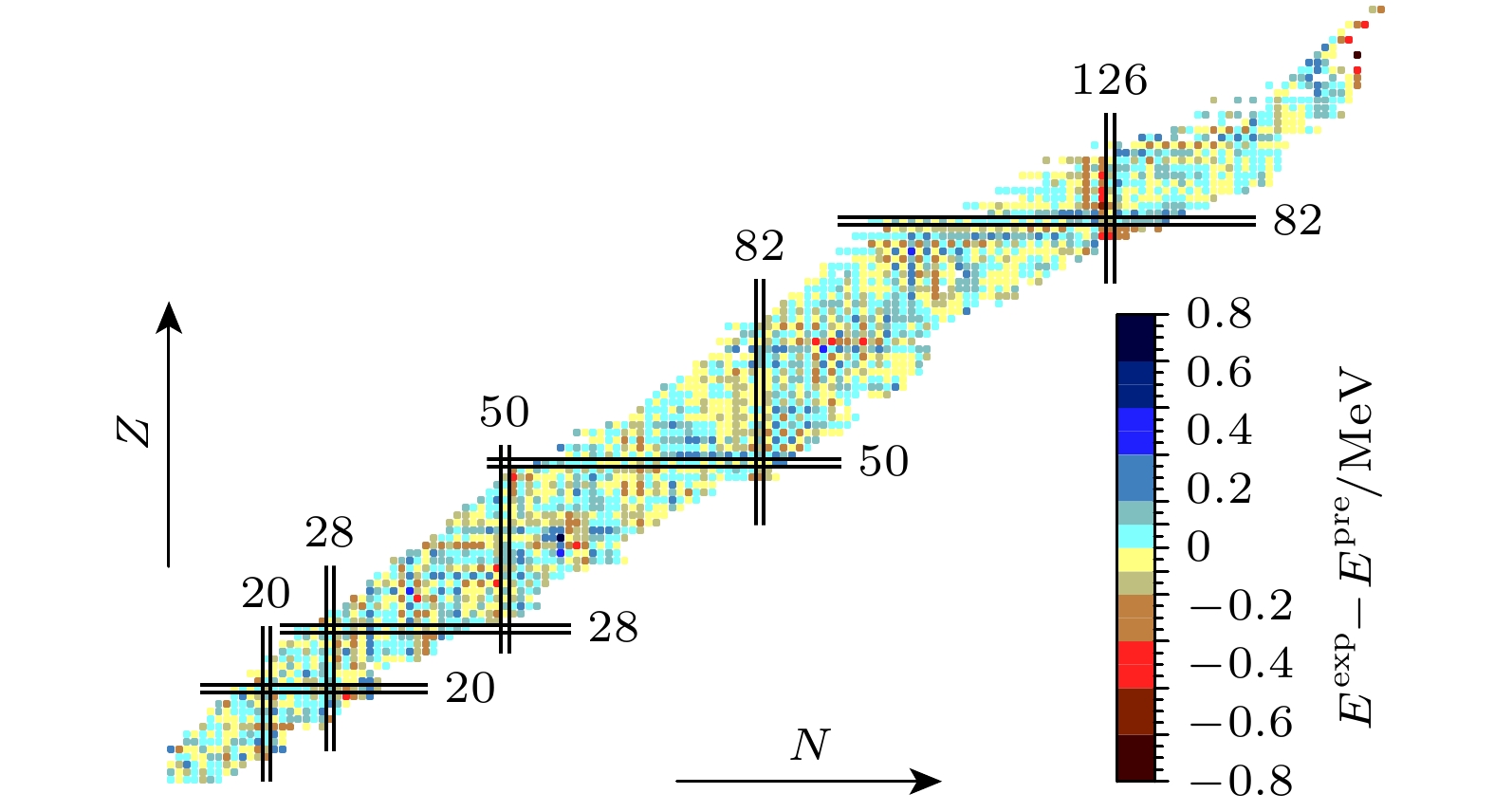
图 7 ANN3对整个核素图上原子核结合能E的预测值与实验值的偏差分布
Fig. 7. Distribution of prediction residuals of ANN3 with respect to experimental values on the nuclear chart for the binding energy E.
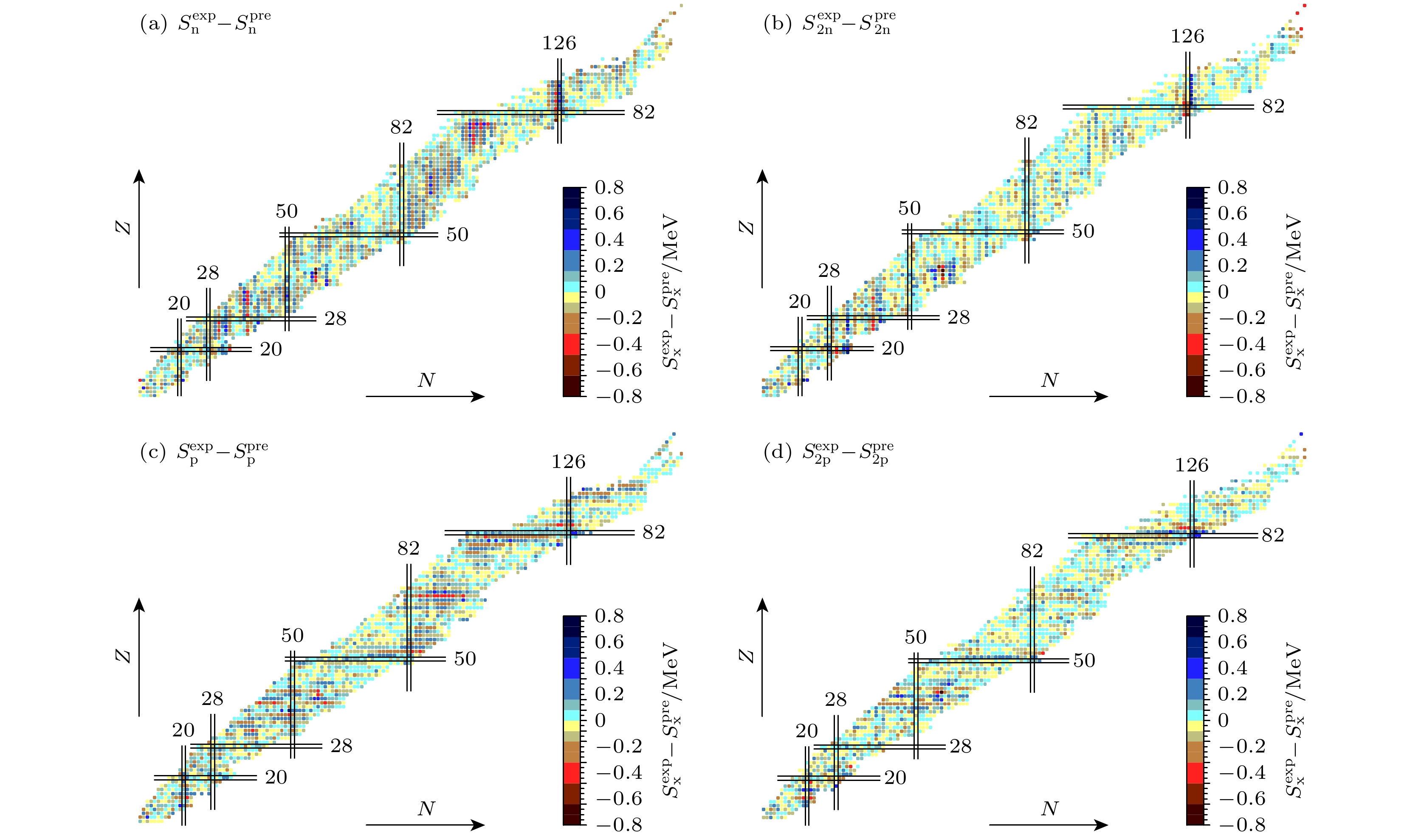
图 8 ANN3对整个核素图上原子核单/双中子分离能$ S_\mathrm{n} $(a), $ S_\mathrm{2 n} $(b)以及单/双质子分离能$ S_\mathrm{p} $(c), $ S_\mathrm{2 p} $(d)的预测值与实验值的偏差分布
Fig. 8. Distribution of prediction residuals of ANN3 with respect to experimental values on the nuclear chart for the one- and two-neutron separation energies $ S_\mathrm{n} $ (a) and $ S_\mathrm{2 n} $ (b), as well as one- and two-proton separation energies $ S_\mathrm{p} $ (c) and $ S_\mathrm{2 p} $ (d).
-
[1] Lunney D, Pearson J M, Thibault C 2003 Rev. Mod. Phys. 75 1021
 Google Scholar
[2] Bender M, Heenen P H, Reinhard P G 2003 Rev. Mod. Phys. 75 121
Google Scholar
[3] Burbidge E M, Burbidge G R, Fowler W A, Hoyle F 1957 Rev. Mod. Phys. 29 547
Google Scholar
[4] Bethe H A 1939 Phys. Rev. 55 434
Google Scholar
[5] Huang W J, Wang M, Kondev F G, Audi G, Naimi S 2021 Chin. Phys. C 45 030002
Google Scholar
[6] Wang M, Huang W J, Kondev F G, Audi G, Naimi S 2021 Chin. Phys. C 45 030003
Google Scholar
[7] Xia X W, LiM Y, Zhao P W, Liang H Z, Qu X Y, Chen Y, Liu H, Zhang L F, Zhang S Q, Kim Y, Meng J 2018 At. Data Nucl. Data Tables 121 1
[8] Bethe H A, Bacher R F 1936 Nucl. Phys. 8 82
[9] Möller P, Myers W D, Sagawa H, Yoshida S 2012 Phys. Rev. Lett. 108 052501
Google Scholar
[10] Geng L, Toki H, Meng J 2005 Prog. Theor. Phys 113 785
Google Scholar
[11] Hua X M, Heng T H, Niu Z M, Sun B H, Guo J Y 2012 Sci. China Phys. Mech. Astron. 55 2414
Google Scholar
[12] Möller P, Sierk A J, Ichikawa T, Sagawa H 2016 At. Data Nucl. Data Tables 109-110 1
Google Scholar
[13] Möller P, Mumpower M R, Kawano T, Myers W D 2019 At. Data Nucl. Data Tables 125 1
Google Scholar
[14] Wang N, Liu M, Wu X Z, Meng J 2014 Phys. Lett. B 734 215
Google Scholar
[15] Neufcourt L, Cao Y C, Nazarewicz W, Viens F 2018 Phys. Rev. C 98 034318
Google Scholar
[16] Otsuka T, Suzuki T, Fujimoto R, Grawe H, Akaishi Y 2005 Phys. Rev. Lett. 95 232502
Google Scholar
[17] Sorlin O, Porquet M G 2008 Prog. Part. Nucl. Phys. 61 602
Google Scholar
[18] Utama R, Piekarewicz J, Prosper H B 2016 Phys. Rev. C 93 014311
Google Scholar
[19] Gao Z P, Wang Y J, Lü H L, Li Q F, Shen C W, Liu L 2021 Nucl. Sci. Tech. 32 109
Google Scholar
[20] Ming X C, Zhang H F, Xu R R, Sun X D, Tian Y, Ge Z G 2022 Nucl. Sci. Tech. 33 48
Google Scholar
[21] Wu X H, Lu Y Y, Zhao P W 2022 Phys. Lett. B 834 137394
Google Scholar
[22] Mumpower M R, Sprouse T M, Lovell A E, Mohan A T 2022 Phys. Rev. C 106 L021301
[23] Niu Z M, Liang H Z 2018 Phys. Lett. B 778 48
Google Scholar
[24] Wu X H, Guo L H, Zhao P W 2021 Phys. Lett. B 819 136387
Google Scholar
[25] Niu Z M, Liang H Z 2022 Phys. Rev. C 106 L021303
Google Scholar
[26] Lu Y H, Shang T S, Du P X, Li J, Liang H Z, Niu Z M 2025 Phys. Rev. C 111 014325
Google Scholar
[27] 陈存宇, 陈爱喜, 戚晓秋, 王韩奎 2025 74 012101
Google Scholar
Chen C Y, Chen A X, Qi X Q, Wang H K 2025 Acta Phys. Sin. 74 012101
Google Scholar
[28] 陶世杰, 张力菲, 张庆一, 刘健, 许昌 2022 中国科学:物理学 力学 天文学 52 252009
Tao S J, Zhang L F, Zhang Q Y, Liu J, Xu C 2022 Sci. China Phys. Mech. Astron. 52 252009
[29] Li Z L, Wang Y J, Li Q F, Lv B F 2025 Phys. Rev. C 112 014312
[30] Costiris N J, Mavrommatis E, Gernoth K A, Clark J W 2009 Phys. Rev. C 80 044332
Google Scholar
[31] Niu Z M, Liang H Z, Sun B H, Long W H, Niu Y F 2019 Phys. Rev. C 99 064307
[32] 李鹏, 白景虎, 牛中明, 牛一斐 2022 中国科学:物理学 力学 天文学 52 252006
Google Scholar
Li P, Bai J H, Niu Z M, Niu Y F 2022 Sci. China Phys. Mech. Astron. 52 252006
Google Scholar
[33] 魏凯文, 尚天帅, 田榕赫, 杨东, 李春娟, 陈军, 李剑, 黄小龙, 朱佳丽 2025 74 182901
Google Scholar
Wei K W, Shang T S, Tian R H, Yang D, Li C J, Chen J, Li J, Huang X L, Zhu J L 2025 Acta Phys. Sin. 74 182901
Google Scholar
[34] Li W F, Zhang X Y, Niu Y F, Niu Z M 2024 J. Phys. G: Nucl. Part. Phys. 51 015103
Google Scholar
[35] Li P, Niu Y F, Niu Z M 2025 Nucl. Sci. Tech. 36 50
Google Scholar
[36] Jin Z S, Yan M S, Zhou H, Cheng A, Ren Z Z, Liu J 2023 Phys. Rev. C 108 014326
Google Scholar
[37] Liu J, Jin Z S, Ren Z Z 2025 Phys. Rev. C 112 024309
[38] Ma N N, Zhao T L, Wang W X, Zhang H F 2023 Phys. Rev. C 107 014310
[39] 陈海军, 盛浩文, 黄文豪, 吴彬琪, 赵天亮, 包小军 2025 74 192301
Google Scholar
Chen H J, Sheng H W, Huang W H, Wu L Q, Zhao T L, Bao X J 2025 Acta Phys. Sin. 74 192301
Google Scholar
[40] Wang Z A, Pei J C, Liu Y, Qiang Y 2019 Phys. Rev. Lett. 123 122501
Google Scholar
[41] Qiao C Y, Pei J C, Wang Z A, Qiang Y, Chen Y J 2021 Phys. Rev. C 103 034621
Google Scholar
[42] Zhao Q, Ren Z X, Zhao P W, Meng J 2022 Phys. Rev. C 106 034315
Google Scholar
[43] Mumpower M R, Surman R, McLaughlin G C, Aprahamian A 2016 Prog. Part. Nucl. Phys. 86 86
Google Scholar

 下载:
下载:
计量
- 文章访问数: 173
- PDF下载量: 2
- 被引次数: 0
