














-
Pentamode metamaterial (PM) is a kind of artificial microstructure extremum material with solid morphology and fluid properties proposed by Milton and Cherkaey. By decoupling the compression and the shear waves, the periodic structure is difficult to be compressed, but the shear deformation occurs easily. Theoretically, acoustic metamaterials consisting of such periodic arrangement of structural units can achieve complete matching with water. Therefore, the characteristics of adjustable modulus anisotropy, small stuffing rate and broadband endow the PMs with excellent acoustic control ability, which has attracted more attention of researchers. In this paper, the narrow-diameter intersection point P (0.25a, 0.25a, 0.25a) of an isotropic three-dimensional PM selected as the reference point in four different directions (X-axis, Y-axis, Z-axis and body diagonal). When the P-point moves, the farther the P-point is, the greater the degree of anisotropy is. The introduction of anisotropy will cause the structural bifurcation of the three-dimensional PM to change structural parameters, and the structural parameters are important factors affecting the band characteristics of the three-dimensional PM of Bragg scattering. In order to study the influence of anisotropy on the band structure and pentamode properties of three-dimensional asymmetric double-cone PMs, we use the finite element simulation software COMSOL to calculate the primitive-cell of three-dimensional anisotropic PMs under Bloch boundary conditions. By adjusting the position of P point, four different types of three-dimensional anisotropic asymmetric double-cone PMs are constructed. Since the anisotropy changes in different directions have different effects on the parameters of the asymmetric double-cone structure, the band characteristics and the pentamode characteristics will also receive different degrees of influence. In this paper, the relationship between the degree of anisotropy and the band gap characteristics, single-mode region and figure of merit (FOM) are given, and the result can provide guidance for the design of asymmetric double-cone PM acoustic device. Compared with the isotropic double-cone PMs, the relative bandwidth of the first band gap of the anisotropic double-cone PMs can be broadened to 123%, and the FOM can be increased to 6.9 times. Due to the introduction of anisotropy, Due to the introduction of anisotropy, the structure of three-dimensional asymmetric double-cone PMs are more complex, the demand for sample fabrication is further improved, and the stability of PMs also reduced. Therefore, PMs with high stability and easy to be fabricated still needs further research and exploration. -
Keywords:
- pentamode metamaterial /
- anisotropy /
- phononic band gap /
- broadband
[1] Milton G W, Cherkaev A V 1995 J. Eng. Mater. Technol. 117 483
 Google Scholar
[2] Kadic M, Bückmann T, Stenger N, Thiel M, Wegener M 2012 Appl. Phys. Lett. 100 191901
Google Scholar
[3] 陈毅, 刘晓宁, 向平, 胡更开 2016 力学进展 46 201609
Google Scholar
Chen Y, Liu X N, Xiang P, Hu G K 2016 Adv. Mech. 46 201609
Google Scholar
[4] 王兆宏, 蔡成欣, 楚杨阳, 刘广顺 2017 光电工程 44 34
Google Scholar
Wang Z H, Cai C X, Chu Y Y, Liu G S 2017 Opto-Electron. Eng. 44 34
Google Scholar
[5] Milton G W, Briane M, Wills J R 2006 New J. Phys. 8 248
Google Scholar
[6] Norris A N 2008 Proc. R. Soc. A 464 2411
Google Scholar
[7] Scandrett L C, Boisvert J E, Howarth T R 2010 J. Acoust. Soc. Am. 127 2856
Google Scholar
[8] Scandrett L C, Boisvert J E, Howarth T R 2011 Wave Motion 48 505
Google Scholar
[9] Boisvert J E, Scandrett L C, Howarth T R 2016 J. Acoust. Soc. Am. 139 3404
Google Scholar
[10] Schittny R, Bückmann T, Kadic M, Wegener M 2013 Appl. Phys. Lett. 103 231905
Google Scholar
[11] Gokhale N H, Cipolla J L, Norris A N 2012 J. Acoust. Soc. Am. 132 4
[12] Kadic M, Buckmann T, Schittny R, Gumbsch P, Wegener M 2014 Phys. Rev. Appl. 2 054007
Google Scholar
[13] Cai C X, Wang Z H, Li Q W, Xu Z, Tian X G 2015 J. Phys. D: Appl. Phys. 48 175103
Google Scholar
[14] Huang Y, Lu X G, Liang G Y, Xu Z 2016 Phys. Lett. A 380 1334
Google Scholar
[15] Wang G, Jin L, Zhang L, Xu Z 2017 AIP Adv. 7 025309
Google Scholar
[16] Tian Y, Wei Q, Cheng Y, Xu Z, Liu X J 2015 Appl. Phys. Lett. 107 221906
Google Scholar
[17] Sun Z Y, Jia H, Chen Y, Wang Z, Yang J 2018 J. Acoust. Soc. Am. 143 1029
Google Scholar
[18] Chen Y, Liu X N, Hu G K 2015 Sci. Rep. 5 15745
Google Scholar
[19] Chen J G, Liu J H, Liu X Z 2018 AIP Adv. 8 085024
Google Scholar
[20] 张向东, 陈虹, 王磊, 赵志高, 赵爱国 2015 64 134303
Google Scholar
Zhang X D, Chen H, Wang L, Zhao Z G, Zhao A G 2015 Acta Phys. Sin. 64 134303
Google Scholar
[21] 陆智淼, 蔡力, 温激鸿, 温熙森 2016 65 174301
Google Scholar
Lu Z M, Cai L, Wen J H, Wen X S 2016 Acta Phys. Sin. 65 174301
Google Scholar
[22] Chen H Y, Chan C T 2007 Appl. Phys. Lett. 91 183518
Google Scholar
[23] Chen H Y, Chan C T 2010 J. Phys. D: Appl. Phys. 43 113001
Google Scholar
[24] Cai C X, Han C, Wu J F, Wang Z H, Zhang Q H 2019 J. Phys. D: Appl. Phys. 52 045601
Google Scholar
[25] Wang Z H, Cai C X, Li Q W, Li J, Xu Z 2016 J. Appl. Phys. 120 024903
Google Scholar
[26] Bückmann T, Schittny R, Thiel M, Kadic M, Milton G W, Wegener M 2014 New J. Phys. 16 033032
Google Scholar
-

图 1 (a)各向同性五模超材料晶胞与(b)−(e)各向异性五模超材料晶胞结构示意图
Figure 1. The unit cell structure of isotropy (a) and (b)−(e) anisotropic pentamode materials.

图 2 P点沿空间对角线方向偏移0.25倍对角线长度时的能带结构
Figure 2. The band structure of pentamode material with
${O_{\rm{s}}}P/\sqrt 3 a = 0.25$ .
图 3 模型1的第一带隙与单模区域的(a)上下界频率; (b)相对带宽
Figure 3. (a) The upper and lower edges and (b) relative bandwidth of the first phononic band gaps and single mode area of model 1.

图 7 各向异性对非对称双锥五模超材料品质因数的影响
Figure 7. The influence of anisotropy on the figure of merit of asymmetric double-cone pentamode materials.
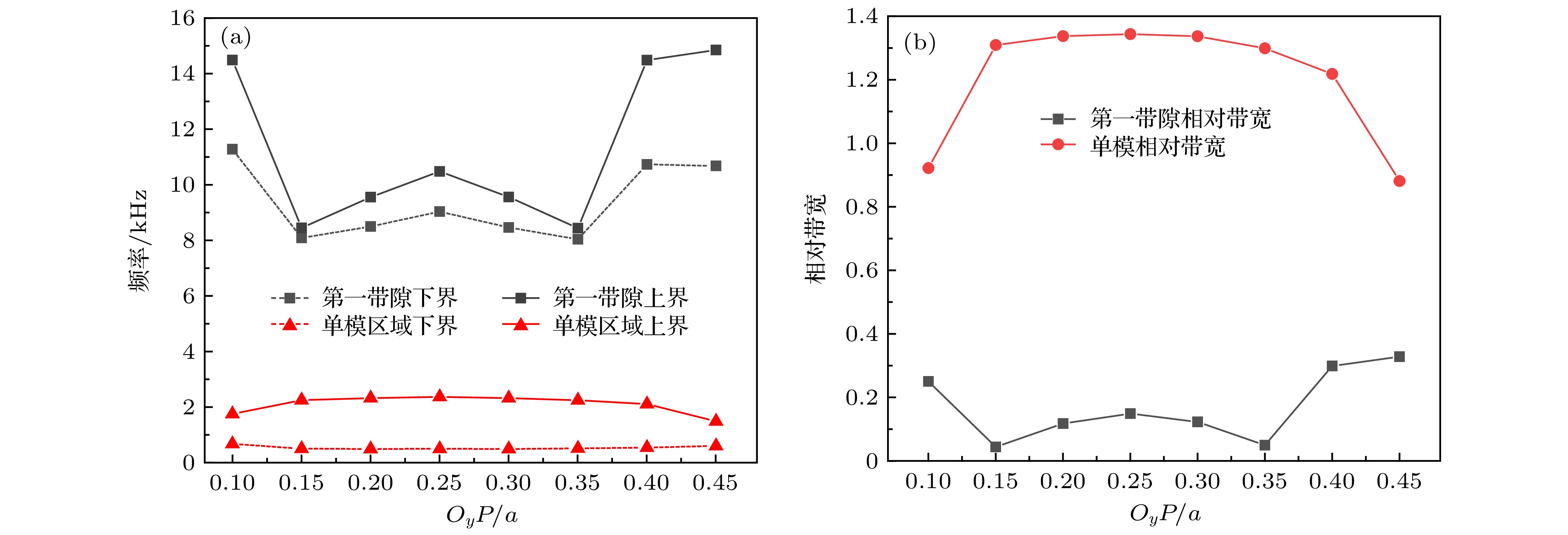
图 4 模型2的第一带隙与单模区域的(a)上下界频率; (b)相对带宽
Figure 4. (a) The upper and lower edges and (b) relative bandwidth of the first phononic band gaps and single mode area of model 2.
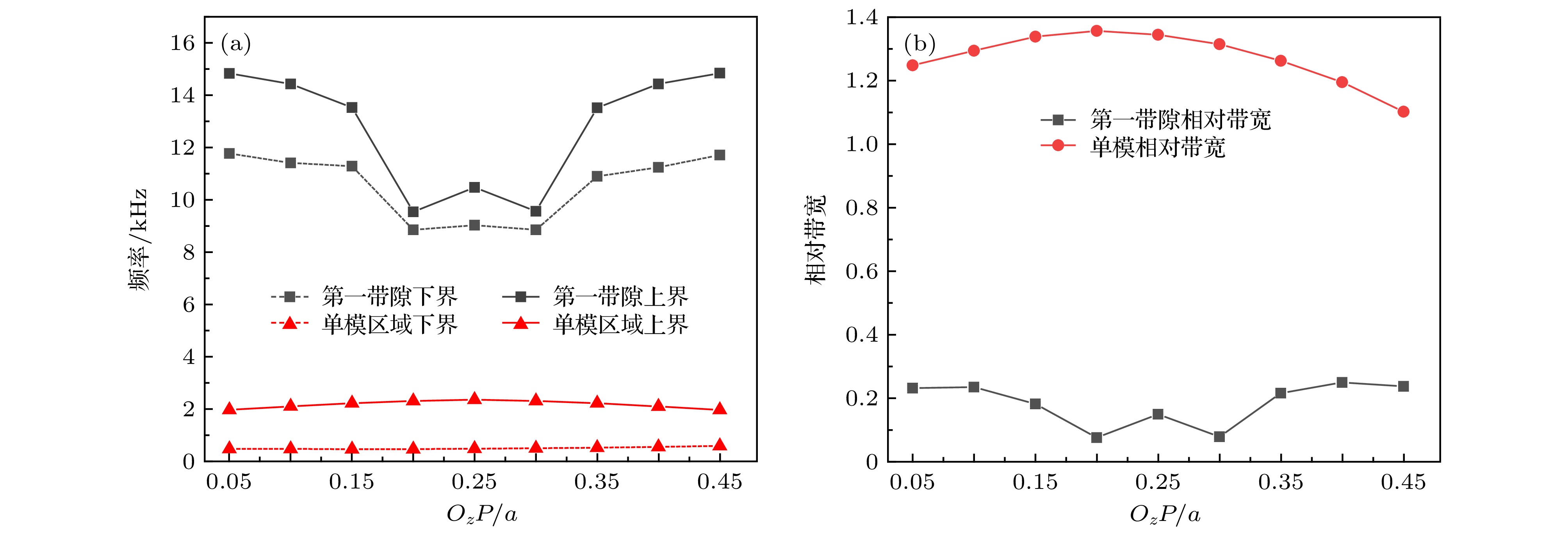
图 5 模型3的第一带隙与单模区域的(a)上下界频率; (b)相对带宽
Figure 5. (a) The upper and lower edges and (b) relative bandwidth of the first phononic band gaps and single mode area of model 3.

图 6 模型4的第一带隙与单模区域的(a)上下界频率; (b)相对带宽
Figure 6. (a) The upper and lower edges and (b) relative bandwidth of the first phononic band gaps and single mode area of model 4.
-
[1] Milton G W, Cherkaev A V 1995 J. Eng. Mater. Technol. 117 483
Google Scholar
[2] Kadic M, Bückmann T, Stenger N, Thiel M, Wegener M 2012 Appl. Phys. Lett. 100 191901
Google Scholar
[3] 陈毅, 刘晓宁, 向平, 胡更开 2016 力学进展 46 201609
Google Scholar
Chen Y, Liu X N, Xiang P, Hu G K 2016 Adv. Mech. 46 201609
Google Scholar
[4] 王兆宏, 蔡成欣, 楚杨阳, 刘广顺 2017 光电工程 44 34
Google Scholar
Wang Z H, Cai C X, Chu Y Y, Liu G S 2017 Opto-Electron. Eng. 44 34
Google Scholar
[5] Milton G W, Briane M, Wills J R 2006 New J. Phys. 8 248
Google Scholar
[6] Norris A N 2008 Proc. R. Soc. A 464 2411
Google Scholar
[7] Scandrett L C, Boisvert J E, Howarth T R 2010 J. Acoust. Soc. Am. 127 2856
Google Scholar
[8] Scandrett L C, Boisvert J E, Howarth T R 2011 Wave Motion 48 505
Google Scholar
[9] Boisvert J E, Scandrett L C, Howarth T R 2016 J. Acoust. Soc. Am. 139 3404
Google Scholar
[10] Schittny R, Bückmann T, Kadic M, Wegener M 2013 Appl. Phys. Lett. 103 231905
Google Scholar
[11] Gokhale N H, Cipolla J L, Norris A N 2012 J. Acoust. Soc. Am. 132 4
[12] Kadic M, Buckmann T, Schittny R, Gumbsch P, Wegener M 2014 Phys. Rev. Appl. 2 054007
Google Scholar
[13] Cai C X, Wang Z H, Li Q W, Xu Z, Tian X G 2015 J. Phys. D: Appl. Phys. 48 175103
Google Scholar
[14] Huang Y, Lu X G, Liang G Y, Xu Z 2016 Phys. Lett. A 380 1334
Google Scholar
[15] Wang G, Jin L, Zhang L, Xu Z 2017 AIP Adv. 7 025309
Google Scholar
[16] Tian Y, Wei Q, Cheng Y, Xu Z, Liu X J 2015 Appl. Phys. Lett. 107 221906
Google Scholar
[17] Sun Z Y, Jia H, Chen Y, Wang Z, Yang J 2018 J. Acoust. Soc. Am. 143 1029
Google Scholar
[18] Chen Y, Liu X N, Hu G K 2015 Sci. Rep. 5 15745
Google Scholar
[19] Chen J G, Liu J H, Liu X Z 2018 AIP Adv. 8 085024
Google Scholar
[20] 张向东, 陈虹, 王磊, 赵志高, 赵爱国 2015 64 134303
Google Scholar
Zhang X D, Chen H, Wang L, Zhao Z G, Zhao A G 2015 Acta Phys. Sin. 64 134303
Google Scholar
[21] 陆智淼, 蔡力, 温激鸿, 温熙森 2016 65 174301
Google Scholar
Lu Z M, Cai L, Wen J H, Wen X S 2016 Acta Phys. Sin. 65 174301
Google Scholar
[22] Chen H Y, Chan C T 2007 Appl. Phys. Lett. 91 183518
Google Scholar
[23] Chen H Y, Chan C T 2010 J. Phys. D: Appl. Phys. 43 113001
Google Scholar
[24] Cai C X, Han C, Wu J F, Wang Z H, Zhang Q H 2019 J. Phys. D: Appl. Phys. 52 045601
Google Scholar
[25] Wang Z H, Cai C X, Li Q W, Li J, Xu Z 2016 J. Appl. Phys. 120 024903
Google Scholar
[26] Bückmann T, Schittny R, Thiel M, Kadic M, Milton G W, Wegener M 2014 New J. Phys. 16 033032
Google Scholar


 DownLoad:


Catalog
Metrics
- Abstract views: 12044
- PDF Downloads: 198
- Cited By: 0
