













-
非晶合金具有远超于传统金属材料的高强度、高硬度, 但由于非晶合金的塑性变形高度局限于剪切带内, 致使它的室温塑性变形能力极差. 晶体-非晶、非晶-非晶双相结构是解决非晶合金塑性差、脆性高的有效策略之一. 相变可实现从单一的晶体、非晶结构向晶体-非晶、非晶-非晶双相结构的转变, 通过相变过程中的能量耗散与结构重组, 实现超高强度与大的均匀塑性变形. 衍生的双相合金可以继承非晶合金的独特性能, 如: 优异的力学性能、软硬磁性能、储氢性能及催化性能等. 基于此, 本文综述了晶体-非晶、非晶-非晶相变行为的研究进展, 着重讨论了如何通过机械载荷、热处理等手段诱导相变的发生, 同时强调了混合焓设计、元素配分对相变行为的重要影响. 最后, 本文对晶体-非晶与非晶-非晶双相材料的力学和功能特性进行了简单概述.
Unlike traditional crystalline metals, amorphous alloys exhibit a distinctive atomic arrangement characterized by short-range order and long-range disorder. Consequently, they lack dislocations, grain boundaries and other traditional crystalline defects, thus demonstrating very high strength and hardness. However, their plastic deformation is highly localized into nanoscale shear bands, which readily leads to catastrophic fracture and results in very poor room-temperature ductility. Forming crystalline-amorphous or amorphous-amorphous dual-phase structure is an effective strategy to solve the problems of the brittleness and limited plasticity of amorphous alloys. On the one hand, such heterogeneous architectures promote the formation of multiple shear bands, thereby dissipating energy and redistributing stress; on the other hand, when the amorphous phase size is reduced below roughly 100 nm, the glassy phase can be deformed by homogeneous flow, and the interactions between nanoscale amorphous regions and dislocation activity in the crystalline phase are conductive to more uniform macroscopic plasticity. Mechanical loading, heat treatment, and other processing routes can induce the transformation from crystalline single-phase or amorphous states to crystalline-amorphous or amorphous–amorphous dual-phase structures, thereby enabling the simultaneous attainment of ultrahigh strength and significant uniform plastic deformation. The resulting dual-phase alloys can retain the unique properties of amorphous alloys. Accordingly, this review summarizes recent advances in crystalline-amorphous and amorphous-amorphous phase- transformation behaviors below. 1) Mechanical loading, such as friction and TRIP effects, can induce phase transformations. During frictional wear, materials experience large shear strains and stress concentrations; when combined with chemical reaction, these conditions can lead to the formation of crystalline-amorphous dual-phase structures at the surface. Under externally applied loads, phase transformations and microstructural reconfiguration occur; crystalline–amorphous and amorphous-amorphous TRIP effects become the primary mechanisms for energy dissipation, thereby delaying local stress concentration and improving ductility and fracture resistance. 2) Thermal annealing above the glass transition temperature commonly induces crystallization of amorphous alloys, leading to in-situ precipitation of nanocrystals within the amorphous matrix. By controlling the annealing temperature and time, the size and volume fraction of the precipitates can be regulated, and more refined heat-treatment paths can even induce amorphous-amorphous transformation. 3) Mixing enthalpy design and elemental partitioning play an important role in crystalline-amorphous and amorphous–amorphous phase behaviors. Elements with large negative mixing enthalpies tend to attract and enrich one another, whereas those with positive mixing enthalpies tend to repel; mechanical loading, thermal treatment and other external driving forces further promote atomic diffusion and elemental redistribution, which mediate the formation of crystalline-amorphous and amorphous-amorphous dual-phase structures. 4) These unique structures endow crystalline-amorphous and amorphous-amorphous dual-phase alloys with excellent strength-ductility combinations as well as advantageous magnetic, hydrogen-storage, and catalytic properties. Future research should concentrate on three directions: Ⅰ) establishing a thermodynamic design framework centered on mixing enthalpy to clarify how compositional changes affect phase stability; Ⅱ) developing large-scale, and mass-producible routes for dual-phase materials; and Ⅲ) designing application-oriented dual-phase alloy systems that are low-cost, simple to fabricate, and have long service lives, thereby accelerating their industrial deployment in energy, precision machinery, electronics and communications, aerospace, and biomedical fields. -
Keywords:
- crystalline-amorphous /
- amorphous-amorphous /
- elemental partitioning /
- phase transformation
-
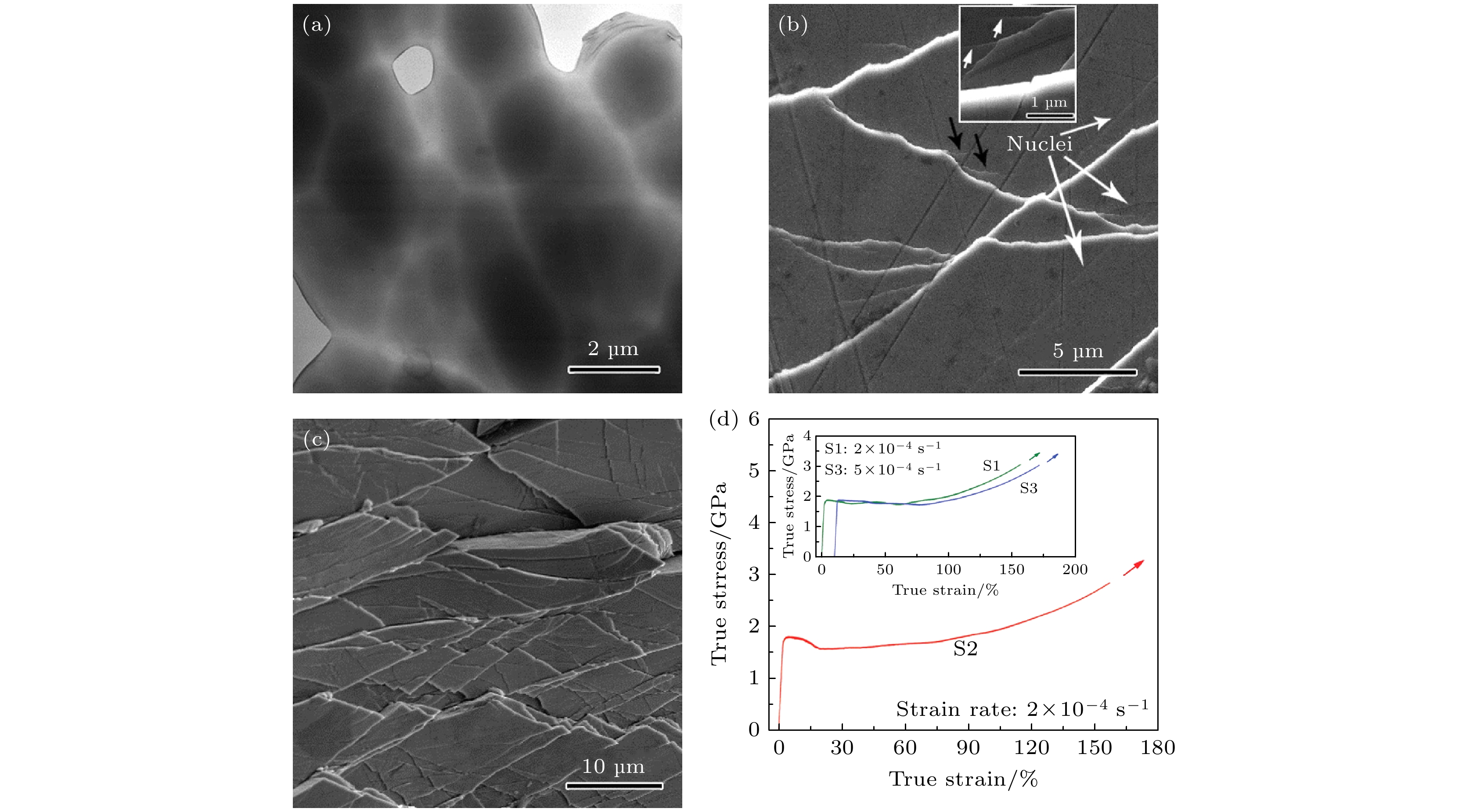
图 1 Zr-Cu-Ni-Al非晶合金的微观显微图像及试样的真应力-应变曲线 (a) 试样的TEM图像, 暗区被亮区包围(分别对应于硬区和软区), 其中一些软区被薄化成孔[25]; (b), (c) 试样表面的扫描电镜(SEM)图像, 分别对应约2.7%和159%的真塑性应变, 图(b)中剪切带呈波浪状, 黑色箭头表示翼状剪切带, 插图显示了沿着过早的波浪形剪切带(箭头)的翼状剪切带[25]; (d) 试样的真应力-应变曲线(室温条件下)[25]
Fig. 1. Micrographs of the Zr–Cu–Ni–Al amorphous alloy and the true stress–strain curve of the specimen: (a) TEM image of the specimen showing dark regions surrounded by bright regions (corresponding to hard and soft regions, respectively); some of the soft regions have been thinned into pores[25]; (b), (c) scanning electron microscopy (SEM) images of the specimen surface corresponding to true plastic strains of ~2.7% and ~159, respectively. In Figure (b) the shear bands are wavy, black arrows indicate winged shear bands, and the inset shows winged shear bands propagating along a prematurely formed wavy shear band (arrow)[25]; (d) true stress–strain curve of the specimen tested at room temperature[25].
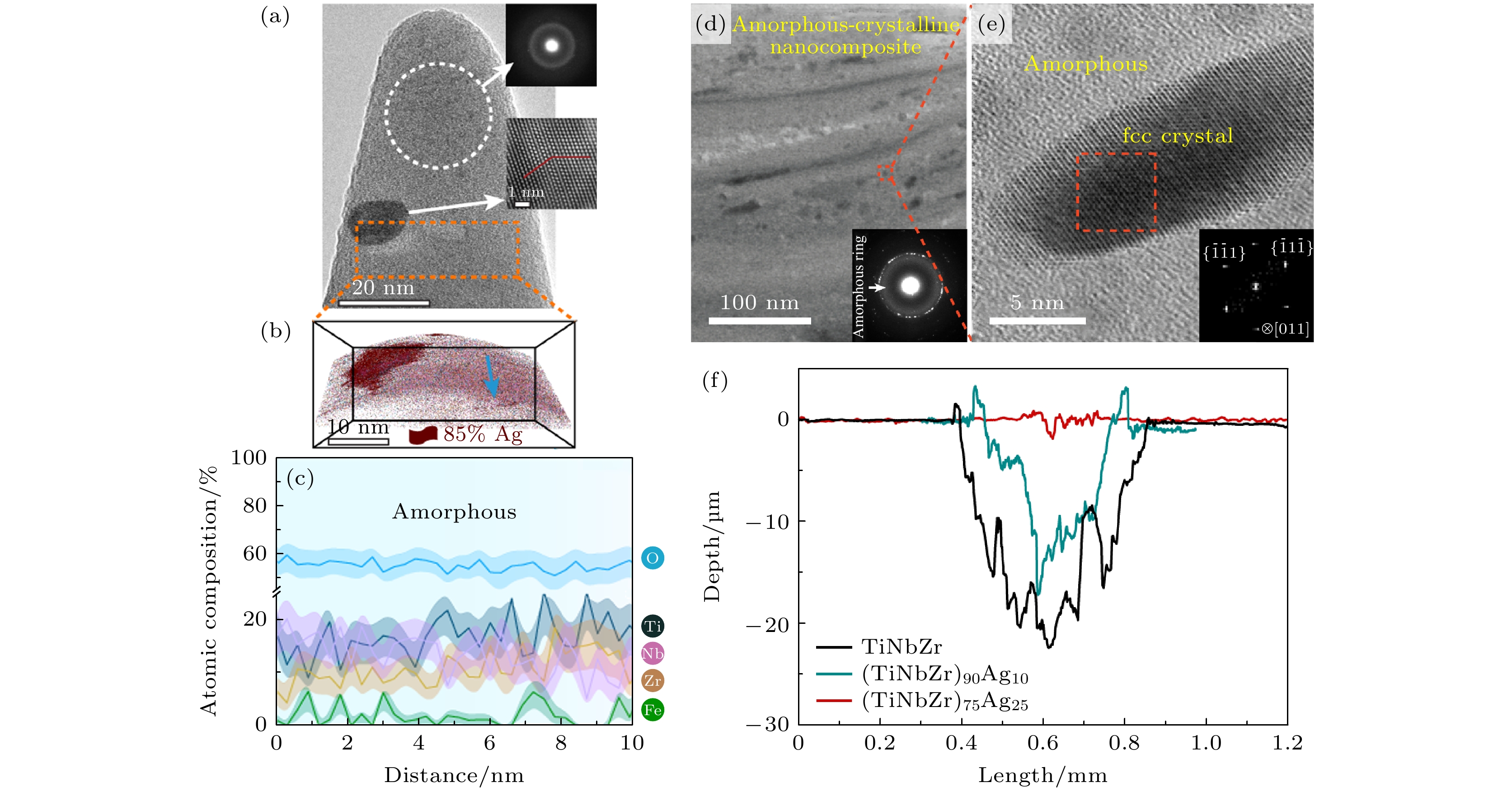
图 2 (NbTiZr)75Ag25合金薄膜在摩擦过程中原位构建的非晶-纳米晶双相结构 (a) 顶部的插图是白色虚线圆圈区域的选区电子衍射(SAED)图案, 显示了非晶相的晕环图案, 中间的插图是图(a)中纳米晶体的放大图[57]; (b) 图(a)中橘色虚线方框区域的APT数据集的3D重建[57]; (c) 沿图(b)中所示的箭头测量的1D成分分布[57]; (d) 环形明场扫描透射电子显微镜(ABF-STEM)图像, 显示纳米复合材料的结构[57]; (e) 纳米复合材料的原子分辨扫描透射电子显微镜(ABF-STEM)图像, 呈现嵌入无定形基质中的FCC结构化纳米晶体[57]; (f) 样品磨损痕迹的2D横截面轮廓[57]
Fig. 2. Amorphous–nanocrystalline dual-phase structure constructed in situ during friction in a (NbTiZr)75Ag25 alloy thin film: (a) Selected area electron diffraction (SAED) pattern from the white dashed circle in Figure (a), showing a halo ring characteristic of the amorphous phase. The middle inset presents an enlarged view of the nanocrystal in Figure (a) [57]; (b) three-dimensional atom probe tomography (APT) reconstruction of the region marked by the orange dashed box in Figure (a)[57]; (c) one-dimensional compositional profile along the arrow in Figure (b)[57]; (d) annular bright-field scanning transmission electron microscopy (ABF-STEM) image of the nanocomposite[57]; (e) atomic-resolution ABF-STEM image revealing FCC nanocrystals embedded in the amorphous matrix[57]; (f) two-dimensional cross-sectional profile of the wear track on the sample[57].

图 3 型锻Cr-Mn-Fe-Co-Ni HEA在准静态压缩下的变形微观组织 (a)透射电镜明场图像显示出大量的平面变形特征[52]; (b)严重变形区域的高分辨率透射电镜显微照片, 具有三个不同的变形孪生区域、HCP相和一个非晶区域, 相应的晶格图像分别以(c)—(e)给出, 图(d)中的HCP区域是傅里叶变换滤波以最大化相差[52]
Fig. 3. Deformation microstructure of the swaged Cr–Mn–Fe–Co–Ni HEA under quasi-static compression: (a) Bright-field TEM image showing numerous planar deformation features[52]; (b) high-resolution TEM micrograph of a heavily deformed region, displaying three distinct deformation twin regions, an HCP phase, and an amorphous region; the corresponding lattice images are shown in (c)—(e), The HCP region in (d) is Fourier-transform filtered to maximize phase contrast[52].
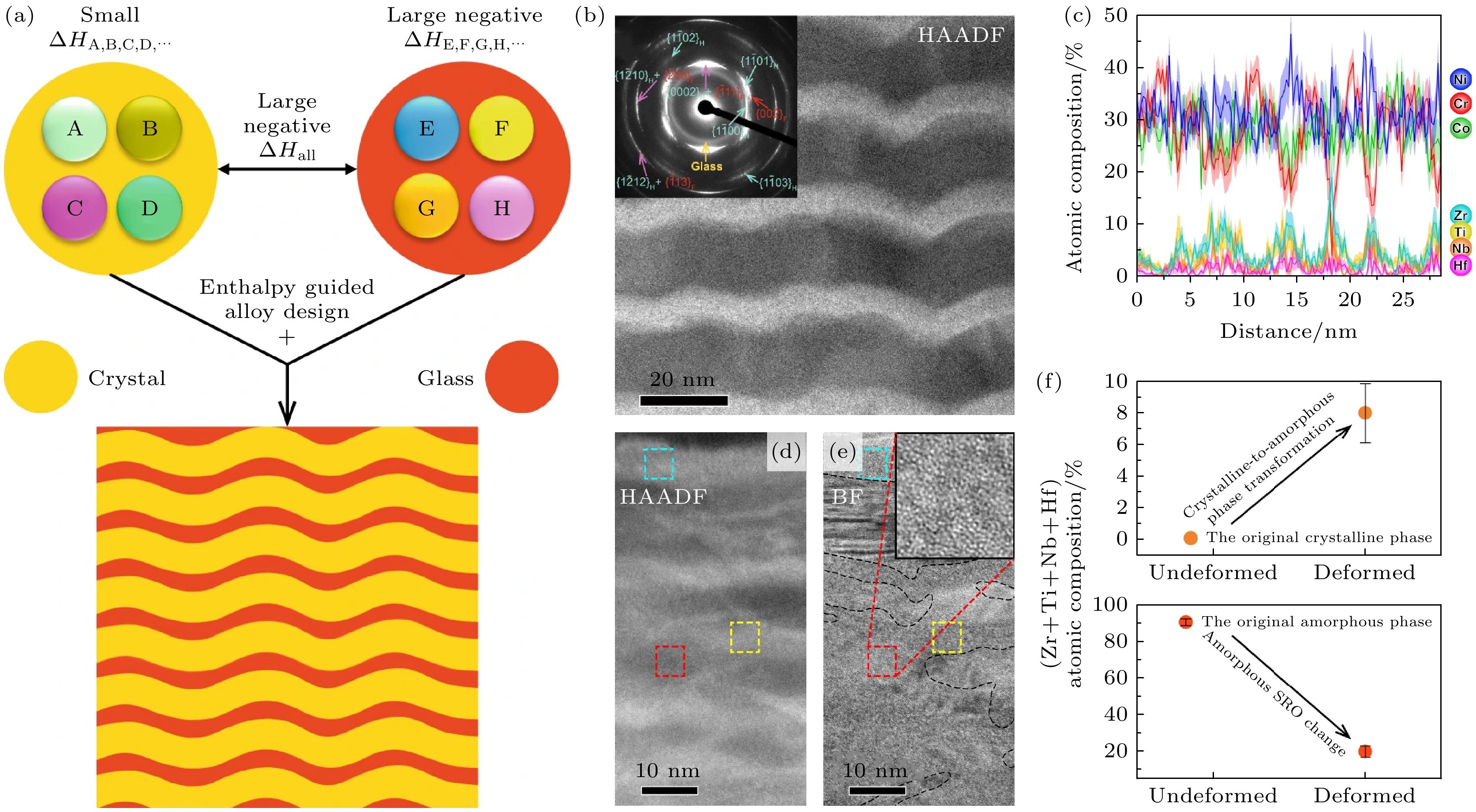
图 4 元素配分介导的Cr-Ni-Co(晶态)/Zr-Ti-Nb-Hf-Ni-Co(非晶态)纳米层状复合材料CA-TRIP式相变过程 (a) 合金设计策略的示意图[68]; (b) 典型的侧视图高角度环形暗场扫描透射电子显微镜(HAADF-STEM)图像, 显示纳米层压结构, 插图是相应的SAED图案, 由无定形晕环和晶体FCC/HCP平面索引[68]; (c) 双相结构的三维原子探针图[68]; (d) 变形材料的横截面HAADF-STEM图像, 红色方框为晶体区域, 黄色方框为非晶区域[68]; (e) 图(d)的相应的明场扫描透射电子显微镜(BF-STEM)图像, 插图是红色虚线方形区域的放大图像, 呈现出无定形结构[68]; (f) 原始结晶相和非晶相分别在变形前后Zr, Ti, Nb, Hf的总浓度[68]
Fig. 4. Elemental-partitioning-mediated CA-TRIP phase-transformation process in a Cr–Ni–Co (crystalline)/Zr–Ti–Nb–Hf–Ni–Co (amorphous) nanolayered composite: (a) Schematic illustration of the alloy design strategy[68]; (b) representative side-view high-angle annular dark-field scanning transmission electron microscopy (HAADF-STEM) image showing the nanolamellar structure; the inset is the corresponding SAED pattern, consisting of amorphous halos and indexed FCC/HCP planes[68]; (c) APT map of the dual-phase structure[68]; (d) cross-sectional HAADF-STEM image of the deformed material, with the crystalline region highlighted by the red box and the amorphous region by the yellow box[68]; (e) corresponding bright-field STEM (BF-STEM) image of Figure (d); the inset shows an enlarged view of the red dashed square, revealing the amorphous structure[68]; (f) Total concentrations of Zr, Ti, Nb, and Hf in the crystalline and amorphous phases before and after deformation[68].
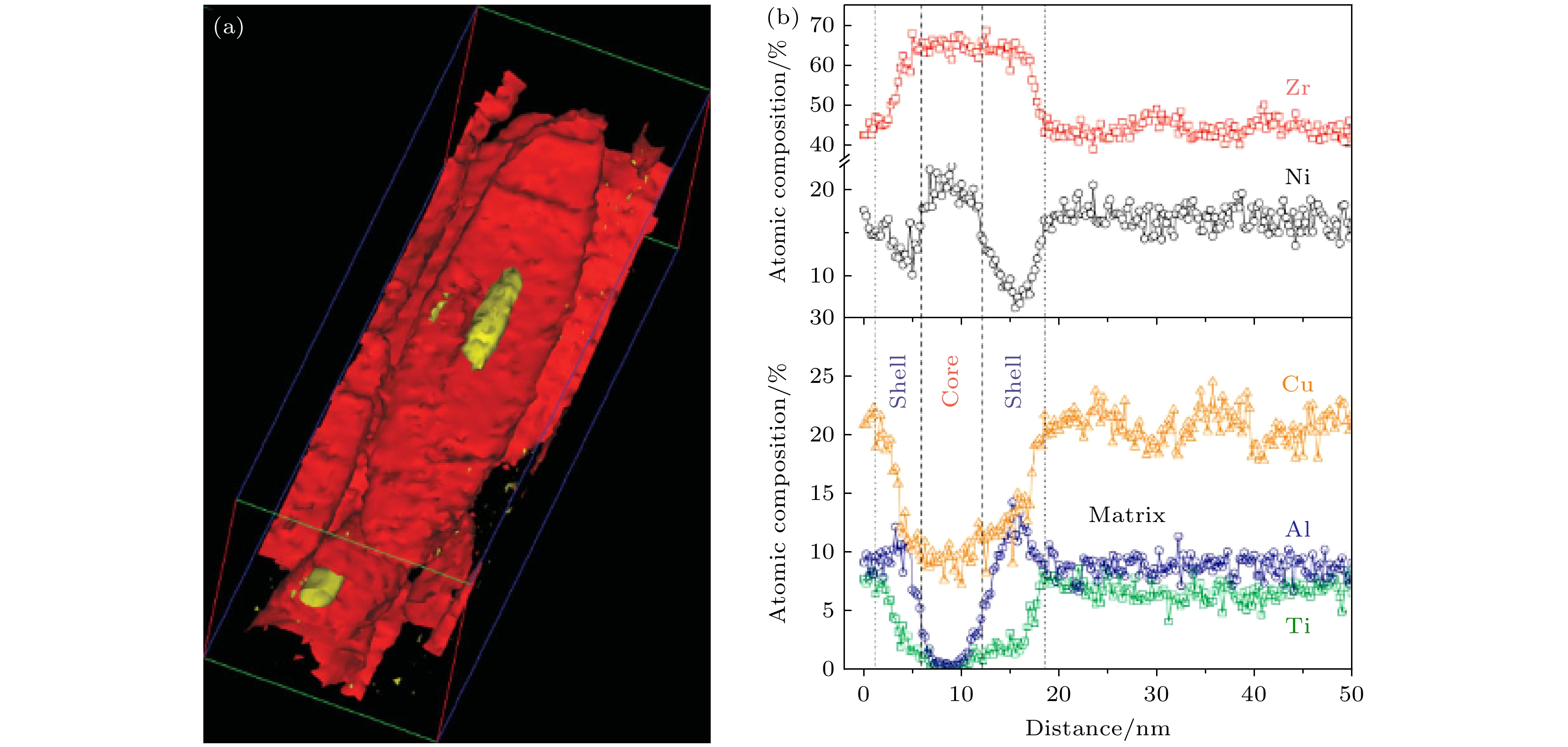
图 5 Zr-Cu-Ni-Al-Ti非晶-纳米晶的APT图像, 呈现出核-壳结构 (a) 由APT分析确定的等浓度面, 显示出富Zr析出相的透镜状形貌及其内部富Al核心区. 红色等浓度面(52% Zr, 原子百分比)和黄色等浓度面(5.4% Al, 原子百分比)分别对应析出相/基体界面和析出相/核心界面[71]; (b) 穿过透镜状析出相中心的线性成分分布曲线. Al原子被排斥出核心区, 而Ti原子则在核心区和包壳区均被排斥[71]
Fig. 5. Atom probe tomography (APT) image of the Zr–Cu–Ni–Al–Ti amorphous–nanocrystalline material, showing a core–shell structure: (a) Isoconcentration surfaces determined by APT analysis, showing a lens-shaped Zr-rich precipitate with an Al-enriched core. The red isoconcentration surface (52% Zr, atomic percent) corresponds to the precipitate/matrix interface, while the yellow isoconcentration surface (5.4% Al, atomic percent) delineates the precipitate/core interface[71]; (b) one-dimensional compositional profile across the center of the lens-shaped precipitate. Al atoms are depleted from the core, whereas Ti atoms are rejected from both the core and the surrounding shell[71].
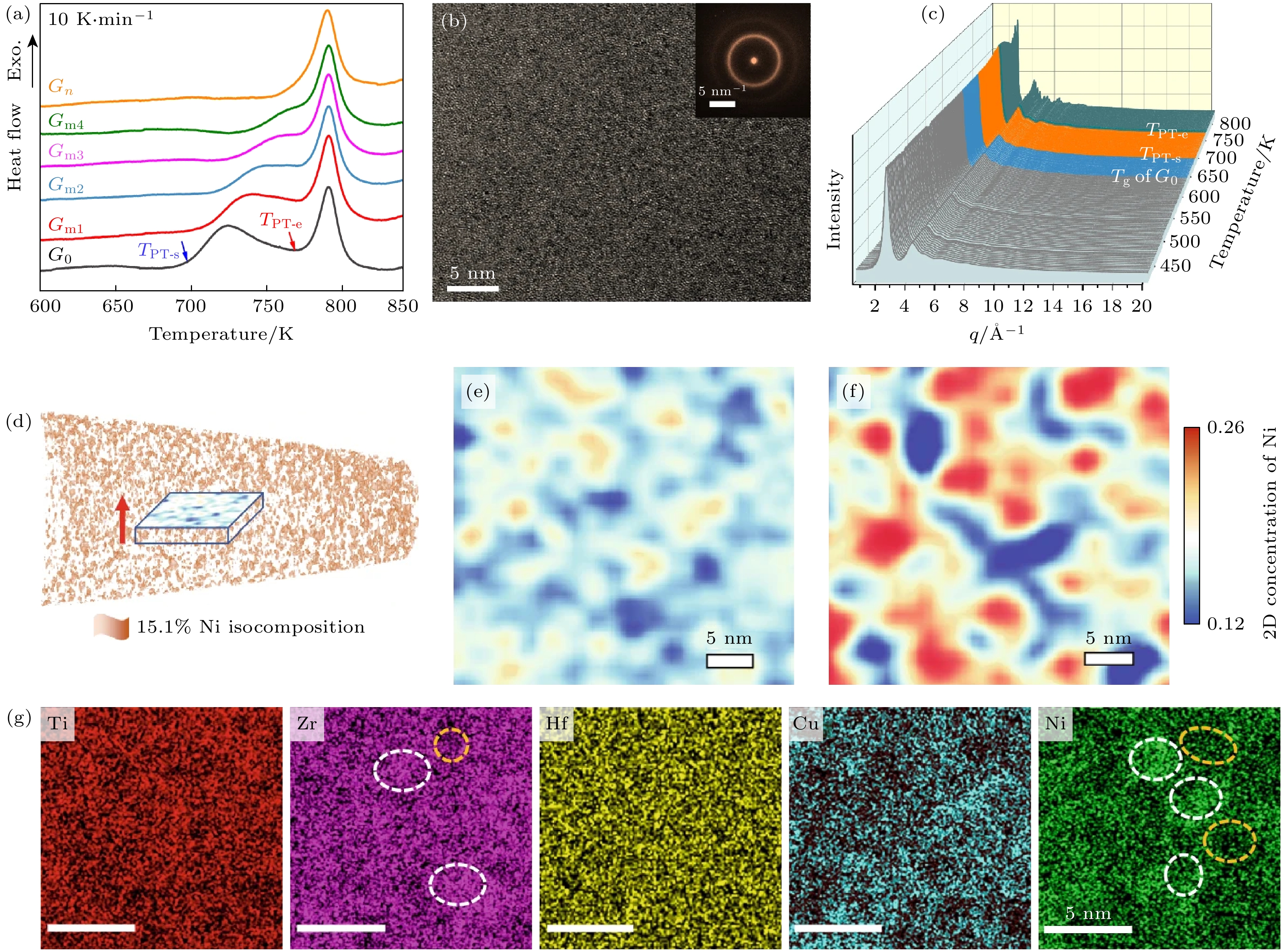
图 7 Ti-Zr-Hf-Cu-Ni高熵非晶合金的连续多形转变过程 (a) 原位DSC扫描曲线: 展示了原始制备的TiZrHfCuNi高熵非晶合金(HEMG, G0)及经713, 726, 740, 753和771 K预热处理后的样品(分别命名为Gm1—Gm4和Gn)[50]; (b) 样品Gn的HRTEM图像及其对应的SEAD花样[50]; (c) 在不同温度下采集的同步辐射XRD曲线, 各相变的温度区间以不同颜色标示; (d) G0的APT尖端重建图, 等成分面阈值设为15.1.%[50]; (e), (f) 分别对应G0和Gn样品在40 nm×40 nm×5 nm体积范围内的二维Ni浓度分布图[50]; (g) Gn中各元素的高角环形暗场扫描透射电子显微镜–能谱(HAADF‑EDS)映射. 白色和黄色虚线圆分别标示出元素浓度较高和较低的区域[50]
Fig. 7. Continuous polymorphic-transformation process of the Ti–Zr–Hf–Cu–Ni high-entropy amorphous alloy: (a) In situ DSC traces of the as-prepared TiZrHfCuNi high-entropy amorphous alloy (HEMG, G0) and samples preheated at 713, 726, 740, 753, and 771 K (denoted as Gm1–Gm4 and Gn, respectively)[50]; (b) HRTEM image of sample Gn with the corresponding SAED pattern[50]; (c) synchrotron XRD patterns collected at different temperatures, with phase transition intervals highlighted in different colors[50]; (d) APT tip reconstruction of G0with an isocomposition threshold of 15.1% [50]; (e), (f) two-dimensional Ni concentration maps over a 40 nm×40 nm× 5 nm volume for G0 and Gn, respectively[50]; (g) HAADF-EDS mappings of each element in Gn, where the white and yellow dashed circles indicate regions with relatively high and low elemental concentrations, respectively[50].
-
[1] Wang Z, Wang B, Zhang M, Guo R P, Wang X J, Qiao J W, Wang Z H 2024 J. Mater. Eng. Perform. 33 274
 Google Scholar
[2] Inoue A, Takeuchi A 2011 Acta Mater. 59 2243
Google Scholar
[3] Schuh C A, Hufnagel T C, Ramamurty U 2007 Acta Mater. 55 4067
Google Scholar
[4] Freed R L, Vander Sande J B 1978 J. Non-Cryst. Solids 27 9
Google Scholar
[5] Sheng H W, Liu H Z, Cheng Y Q, Wen J, Lee P L, Luo W K, Shastri S D, Ma E 2007 Nat. Mater. 6 192
Google Scholar
[6] Pauly S, Gorantla S, Wang G, Kühn U, Eckert J 2010 Nat. Mater. 9 473
Google Scholar
[7] Wu G, Liu S D, Wang Q, Rao J, Xia W Z, Yan Y Q, Eckert J, Liu C, Ma E, Shan Z W 2023 Nat. Commun. 14 3670
Google Scholar
[8] 汪卫华 2022 中国科学院院刊 37 352
Wang W H 2022 BCAS 37 352
[9] Miyoshi K, Buckley D H 1984 Thin Solid Films 118 363
Google Scholar
[10] Yoshizawa Y, Oguma S, Yamauchi K 1988 J. Appl. Phys. 64 6044
Google Scholar
[11] Brenner A, Couch D E, Williams E K 1950 J. Res. Nat. Bur. Stand. 44 109
Google Scholar
[12] Turnbull D, Cohen M H 1958 J. Chem. Phys. 29 1049
Google Scholar
[13] Klement W, Willens R H, Duwez P O L 1960 Nature 187 869
[14] Zhang C Y, Zhu Z W, Li S T, Wang Y Y, Li Z K, Li H, Yuan G, Zhang H F 2024 J. Mater. Sci. Technol. 181 115
Google Scholar
[15] Qin F X, Xie G Q, Dan Z H, Zhu S L, Seki I 2013 Intermetallics 42 9
Google Scholar
[16] Zhang W, Guo H, Li Y H, Wang Y M, Wang H, Chen M W, Yamaura S 2014 J. Alloys Compd. 617 310
Google Scholar
[17] Zeng Y Q, Nishiyama N, Inoue A 2009 Mater. Trans. 50 1243
Google Scholar
[18] Inoue A, Zhang T, Masumoto T 1989 Mater. Trans. 30 965
Google Scholar
[19] Li Q 2006 Mater. Lett. 60 3113
Google Scholar
[20] Inoue A, Shen B L, Koshiba H, Kato H, Yavari A R 2003 Nat. Mater. 2 661
Google Scholar
[21] Li M X, Zhao S F, Lu Z, Hirata A, Wen P, Bai H Y, Chen M W, Schroers J, Liu Y H, Wang W H 2019 Nature 569 99
Google Scholar
[22] Schroers J, Johnson W L 2004 Phys. Rev. Lett. 93 255506
Google Scholar
[23] Zheng Q, Ma H, Ma E, Xu J 2006 Scr. Mater. 55 541
Google Scholar
[24] Gu X J, McDermott A G, Poon S J, Shiflet G J 2006 Appl. Phys. Lett. 88 211905
Google Scholar
[25] Liu Y H, Wang G, Wang R J, Zhao D Q, Pan M X, Wang W H 2007 Science 315 1385
Google Scholar
[26] Hofmann D C, Suh J Y, Wiest A, Duan G, Lind M L, Demetriou M D, Johnson W L 2008 Nature 451 1085
Google Scholar
[27] Rastogi P K, Duwez P 1970 J. Non-Cryst. Solids 5 1
Google Scholar
[28] Duhaj P, Barancok D, Ondrejka A 1976 J. Non-Cryst. Solids 21 411
Google Scholar
[29] Wu Y, Xiao Y H, Chen G L, Liu C T, Lu Z P 2010 Adv. Mater. 22 2770
Google Scholar
[30] Wu Y, Wang H, Wu H H, Zhang Z Y, Hui X D, Chen G L, Ma D, Wang X L, Lu Z P 2011 Acta Mater. 59 2928
Google Scholar
[31] Wu Y, Ma D, Li Q K, Stoica A D, Song W L, Wang H, Liu X J, Stoica G M, Wang G Y, An K, Wang X L, Li M, Lu Z P 2017 Acta Mater. 124 478
Google Scholar
[32] Boucharat N, Hebert R, Rösner H, Valiev R, Wilde G 2005 Scr. Mater. 53 823
Google Scholar
[33] Hebert R J, Perepezko J H 2004 Mater. Sci. Eng. , A 375 728
[34] He Y, Shiflet G J, Poon S J 1995 Acta Metall. Mater. 43 83
Google Scholar
[35] Qin W, Nagase T, Umakoshi Y 2009 Acta Mater. 57 1300
Google Scholar
[36] Nagase T, Umakoshi Y 2003 Scr. Mater. 48 1237
Google Scholar
[37] Shao L, Gorman B P, Aitkaliyeva A, David Theodore N, Xie G Q 2012 Appl. Phys. Lett. 101 041901
Google Scholar
[38] Sypien A, Kusinski J, Kusinski G J, Chris Nelson E 2003 Mater. Chem. Phys. 81 390
Google Scholar
[39] Ichitsubo T, Matsubara E, Yamamoto T, Chen H S, Nishiyama N, Saida J, Anazawa K 2005 Phys. Rev. Lett. 95 245501
Google Scholar
[40] Wu G, Chan K C, Zhu L L, Sun L G, Lu J 2017 Nature 545 80
Google Scholar
[41] Wu G, Liu C, Sun L G, Wang Q, Sun B A, Han B, Kai J J, Luan J H, Liu C T, Cao K, Lu Y, Cheng L Z, Lu J 2019 Nat. Commun. 10 5099
Google Scholar
[42] Wang J G, Choi B W, Nieh T G, Liu C T 2000 J. Mater. Res. 15 913
Google Scholar
[43] Herzer G 1990 IEEE Trans. Magn. 26 1397
Google Scholar
[44] Zhang Y H, Xu C, Yang T, Hou Z H, Zhang G F, Zhao D L 2012 Adv. Mater. Res. 557 1169
[45] Mihailov L, Spassov T, Bojinov M 2012 Int. J. Hydrogen Energy 37 10499
Google Scholar
[46] Zeng Q S, Li Y C, Feng C M, Liermann P, Somayazulu M, Shen G Y, Mao H K, Yang R, Liu J, Hu T D, Jiang J Z 2007 PNAS 104 13565
Google Scholar
[47] Du Q, Liu X J, Zeng Q S, Fan H Y, Wang H, Wu Y, Chen S W, Lu Z P 2019 Phys. Rev. B 99 014208
Google Scholar
[48] Du Q, Liu X J, Fan H Y, Zeng Q S, Wu Y, Wang H, Chatterjee D, Ren Y, Ke Y B, Voyles P M, Lu Z P, Ma E 2020 Mater. Today 34 66
Google Scholar
[49] Lan S, Ren Y, Wei X Y, Wang B, Gilbert E P, Shibayama T, Watanabe S, Ohnuma M, Wang X L 2017 Nat. Commun. 8 14679
Google Scholar
[50] Cao Y H, Yang M, Du Q, Chiang F K, Zhang Y J, Chen S W, Ke Y B, Lou H B, Zhang F, Wu Y, Wang H, Suihe J, Zhang X B, Zeng Q S, Liu X J, Lu Z P 2024 Nat. Commun. 15 6702
Google Scholar
[51] Tsuchiya K, Waitz T, Hara T, Karnthaler H P, Todaka Y, Umemoto M 2008 EMC 2008 14th European Microscopy Congress (Aachen: Springer) p385
[52] Zhao S T, Li Z Z, Zhu C Y, Yang W, Zhang Z R, Armstrong D E J, Grant P S, Ritchie R O, Meyers M A 2021 Sci. Adv. 7 eabb3108
Google Scholar
[53] Song M, Darsell J, Jana S 2022 J. Mater. Sci. 57 12055
Google Scholar
[54] Ren Y, Huang Z B, Wang Y C, Zhou Q, Yang T, Li Q K, Jia Q, Wang H F 2023 Composites Part B 263 110833
Google Scholar
[55] Luo J S, Sun W T, Liang D S, Chan K C, Yang X S, Ren F Z 2023 Acta Mater. 243 118503
Google Scholar
[56] Yin C H, Liang Y L, Liang Y, Li W, Yang M 2019 Acta Mater. 166 208
Google Scholar
[57] Liu C, Li Z M, Lu W J, Bao Y, Xia W Z, Wu X X, Zhao H, Gault B, Liu C L, Herbig M, Fischer A, Dehm G, Wu G, Raabe D 2021 Nat. Commun. 12 5518
Google Scholar
[58] Han H N, Lee C G, Oh C S, Lee T H, Kim S J 2004 Acta Mater. 52 5203
Google Scholar
[59] Zhu R, Li S, Karaman I, Arroyave R, Niendorf T, Maier H J 2012 Acta Mater. 60 3022
Google Scholar
[60] Kwok T W J, Dye D 2023 Int. Mater. Rev. 68 1098
Google Scholar
[61] Zackay V F, Parker E R, Fahr D, Busch R 1967 ASM Trans. Q. 60 252
[62] Richman R H, Bolling G F 1971 Metall. Trans. 2 2451
Google Scholar
[63] Parker E R, Zackay V F 1973 Eng. Fract. Mech. 5 147
Google Scholar
[64] Jiménez Melero E, Van Dijk N H, Zhao L, Sietsma J, Offerman S E, Wright J P, Van Der Zwaag S 2009 Acta Mater. 57 533
Google Scholar
[65] Sugimoto K I, Kobayashi J, Nakajima Y, Kochi T 2014 Mater. Sci. Forum 783 1015
[66] Wu Y, Zhou D Q, Song W L, Wang H, Zhang Z Y, Ma D, Wang X L, Lu Z P 2012 Phys. Rev. Lett. 109 245506
Google Scholar
[67] Fu X L, Wang G, Wu Y, Song W L, Shek C H, Zhang Y, Shen J, Ritchie R O 2020 Int. J. Plast. 128 102687
Google Scholar
[68] Wu G, Liu C, Yan Y Q, Liu S D, Ma X Y, Yue S Y, Shan Z W 2024 Nat. Commun. 15 1223
Google Scholar
[69] Zhang Y, Zhou Y J, Lin J P, Chen G L, Liaw P K 2008 Adv. Eng. Mater. 10 534
Google Scholar
[70] Inoue A 2000 Acta Mater. 48 279
Google Scholar
[71] Yang L, Miller M K, Wang X L, Liu C T, Stoica A D, Ma D, Almer J, Shi D L 2009 Adv. Mater. 21 305
Google Scholar
[72] Shen J, Lu Z, Wang J Q, Lan S, Zhang F, Hirata A, Chen M W, Wang X L, Wen P, Sun Y H, Bai H Y, Wang W H 2020 J. Phys. Chem. Lett. 11 6718
Google Scholar
[73] Dong W X, Wu Z D, Ge J C, Liu S N, Lan S, Gilbert E P, Ren Y, Ma D, Wang X L 2021 Appl. Phys. Lett. 118 191901
Google Scholar
[74] Greer A L, Cheng Y Q, Ma E 2013 Mater. Sci. Eng. , R 74 71
Google Scholar
[75] Zhang T, Inoue A 2004 Mater. Sci. Eng. , A 375 432
[76] Wang J, Kaban I, Levytskyi V, Li R, Han J, Stoica M, Gumeniuk R, Nielsch K 2021 J. Alloys Compd. 860 158398
Google Scholar
[77] Gu X J, Poon S J, Shiflet G J 2007 J. Mater. Res. 22 344
Google Scholar
[78] Nollmann N, Binkowski I, Schmidt V, Rösner H, Wilde G 2016 Scr. Mater. 111 119
Google Scholar
[79] Zhou J, Wu Y, Jiang S H, Song W L, Huang H L, Mao H H, Wang H, Liu X J, Wang X Z, Lu Z P 2020 Mater. Res. Lett. 8 23
Google Scholar
[80] Zhang Q S, Zhang H F, Zhu Z W, Hu Z Q 2005 Mater. Trans. 46 730
Google Scholar
[81] Li F C, Liu T, Zhang J Y, Shuang S, Wang Q, Wang A D, Wang J G, Yang Y 2019 Mater. Today Adv. 4 100027
Google Scholar
[82] Fan C, Inoue A 2000 Appl. Phys. Lett. 77 46
Google Scholar
[83] Lee C M, Chae S W, Kim H J, Lee J C 2007 Met. Mater. Int. 13 191
Google Scholar
[84] Kim H S, Hong S I 1999 Acta Mater. 47 2059
Google Scholar
[85] Wang A D, Zhao C L, He A N, Men H, Chang C T, Wang X M 2016 J. Alloys Compd. 656 729
Google Scholar
[86] Herzer G 1997 Handb. Magn. Mater. 10 415
[87] Wu Y, Dong Y Q, Yang M N, Jia X J, Liu Z H, Lu H, Zhang H J, He A N, Li J W 2022 Metals 12 845
Google Scholar
[88] Jain I P, Lal C, Jain A 2010 Int. J. Hydrogen Energy 35 5133
Google Scholar
[89] Crivello J C, Dam B, Denys R V, Dornheim M, Grant D M, Huot J, Jensen T R, De Jongh P, Latroche M, Milanese C, Milčius D, Walker G. S, Webb C J, Zlotea C, Yartys V A 2016 Appl. Phys. A 122 97
Google Scholar
[90] Huang L J, Wang Y X, Wu D C, Tang J G, Wang Y, Liu J X, Huang Z, Jiao J Q, Liu J Q 2014 J. Power Sources 249 35
Google Scholar
[91] Au M 2005 Mater. Sci. Eng. B 117 37
Google Scholar
[92] Zhang Y H, Wang P P, Bu W G, Yuan Z M, Qi Y, Guo S H 2018 RSC Adv. 8 23353
Google Scholar
[93] Zhang Q A, Jiang C J, Liu D D 2012 Int. J. Hydrogen Energy 37 10709
Google Scholar
[94] Song L M, Li W, Wang G L, Zhang M H, Tao K Y 2007 Catal. Today 125 137
Google Scholar
[95] Deng Y, Yang Y Y, Ge L Y, Yang W Z, Xie K N 2017 Appl. Surf. Sci. 425 261
Google Scholar
[96] Wang P P, Wang J Q, Huo J T, Xu W, Wang X M, Wang G 2017 Sci. China-Phys. Mech. Astron. 60 076112
Google Scholar
[97] Zhao Y M, Chen Q J, Ji L, Wang K, Huang G S 2024 React. Kinet. Mech. Catal. 137 1209
Google Scholar
[98] Zhang J, Qiao M, Li Y F, Shao Q, Huang X Q 2019 ACS Appl. Mater. Interfaces 11 39722
Google Scholar
[99] Ghobrial S, Kirk D W, Thorpe S J 2019 Electrocatalysis 10 243
Google Scholar

 下载:
下载:

计量
- 文章访问数: 713
- PDF下载量: 10
- 被引次数: 0
