













-
光学势作为描述核碰撞相互作用的重要工具, 被广泛应用于核反应机制的研究中. 光学势对核结构具有高度敏感性, 故弱束缚核与紧束缚核的光学势存在显著差异. 大量研究表明, 紧束缚核体系的唯象光学势在近库仑势垒能区表现出阈异常现象, 其实部与虚部的关系可通过色散关系精确描述. 然而对于弱束缚核体系(如6Li、9Be和6He等)引起的反应, 由于在近垒及垒下能区缺乏足够的实验数据, 其光学势的行为仍存在争议. 在中国原子能科学研究院HI-13串列加速器上, 实验测量了6Li+208Pb体系在近垒和深垒能区的弹性散射角分布, 并经光学模型拟合获取其光学势参数. 该体系的光学势呈现出反常的阈异常特征, 且色散关系也不适用于该体系. 此外, 从深垒数据得到6Li+208Pb体系的反应阈值约0.73VB(VB为库仑势垒), 并进一步对不同体系的反应阈值和破裂阈进行了系统学分析. 本工作测量了近垒及深垒能量下6Li+208Pb体系的光学势, 为进一步研究反常阈异常现象提供了数据支持. 本文数据集可在
https://www.doi.org/10.57760/sciencedb.j00213.00218 中访问获取.The optical potential is a key tool for describing interactions in nuclear collisions and is widely used in studies of nuclear reaction mechanisms. It is highly sensitive to nuclear structure, leading to distinct characteristics between weakly bound and tightly bound nuclear systems.For weakly bound nuclei such as 6Li, 9Be and 6He, the behavior of the optical potential remains controversial due to insufficient experimental data at near-barrier and deep-barrier energies.In this work, elastic scattering angular distributions for the 6Li+208Pb system were measured at near-barrier and deep-barrier energies. Optical model fitting was employed to extract the optical potential parameters. The results indicate an anomalous threshold anomaly in the optical potential of this system, and the dispersion relation is not applicable. Furthermore, the reaction threshold for the 6Li+208Pb system was determined to be approximately 0.73VB based on deep-barrier data. A systematic analysis was also performed on the reaction thresholds and breakup thresholds of different nuclear systems.This work measured the optical potential of the 6Li+208Pb system at near-barrier and deep sub-barrier energies, providing data support for further investigation of the anomalous threshold anomaly.The datasets presented in this paper are openly available athttps://www.doi.org/10.57760/sciencedb.j00213.00218 . -
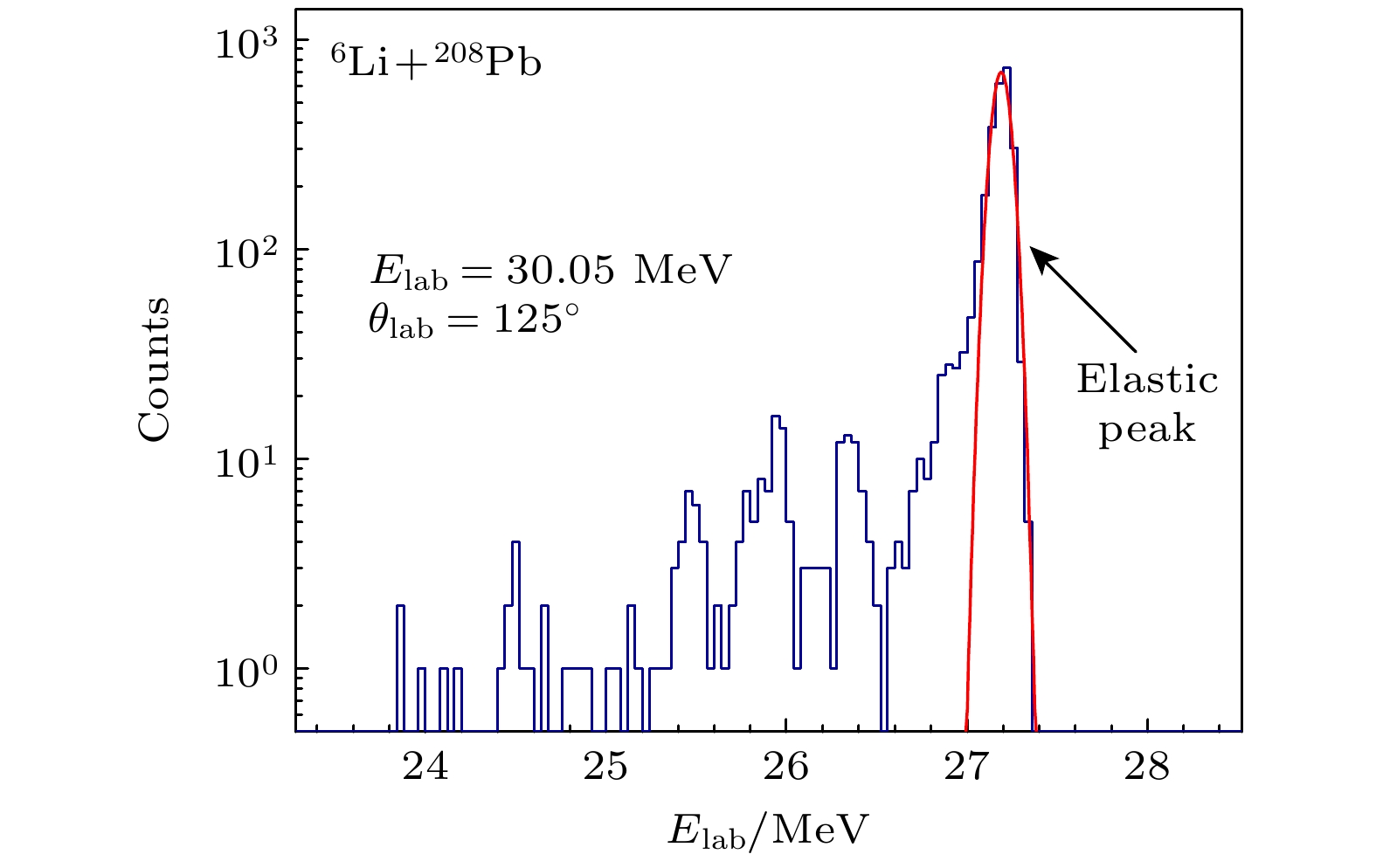
图 2 PIN探测器测得的6Li+208Pb体系的典型能谱
Fig. 2. Typical energy spectrums of the 6Li+208Pb system obtained by the PIN detector.
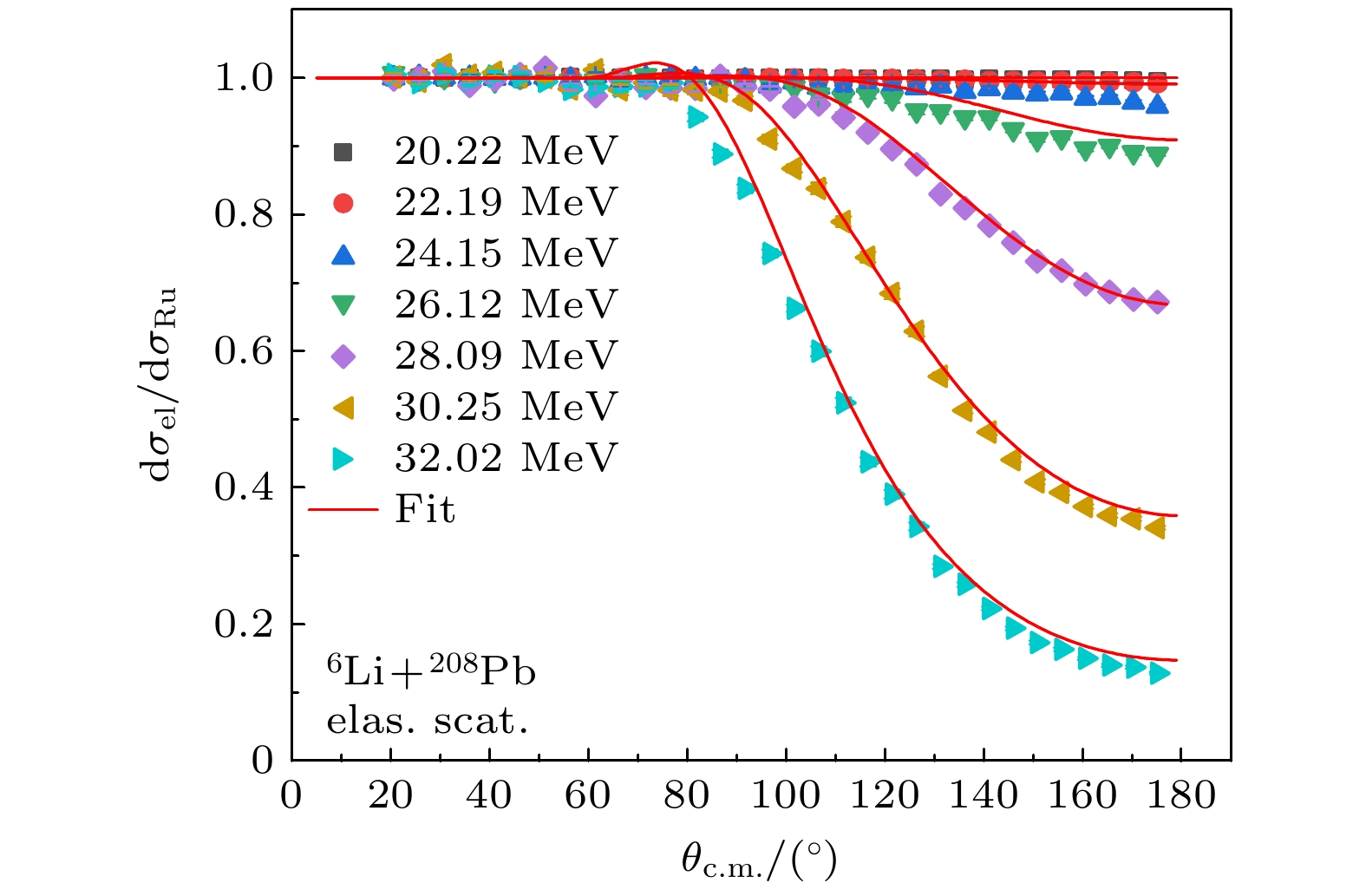
图 3 6Li+208Pb体系在近垒及深垒能量下的弹性散射角分布. 红色实线为FRESCO程序的拟合结果
Fig. 3. Elastic scattering angular distributions for the 6Li+208Pb system at near-barrier and deep-barrier energies.The red solid lines are the fitting results of the FRESCO.

图 4 在灵敏半径$ R_{S} $ = 12.42 fm处, 6Li+208Pb体系实势(a)和虚势(b). 图(a)中的红色实线是虚部的分段线性拟合曲线, 图(b)中的红色实线是由色散关系计算出实部的预测曲线. 本次实验结果由圆点表示, 高能处的星形点数据来自文献[27]
Fig. 4. At the sensitivity radius of 12.42 fm, the real (a) and imaginary (b) potentials of the 6Li+208Pb system. The solid red line in Figure (a) is the piecewise linear fit curve of the imaginary part, while in Figure (b) is the predicted curve of the real part calculated based on the dispersion relation. The present results are shown by the circles, and asterisks represent the results taken from Ref. [27].

图 5 不同体系反应阈值与破裂阈的关系
Fig. 5. The relationship between the reaction threshold and the breakup threshold in different systems.
表 1 从6Li+208Pb体系的弹性散射角分布提取出的光学势参数, 拟合过程中所有的几何参数固定为$ r_{V} $ = 1.15 fm, $ a_{V} $ = 0.66 fm, $ r_{W} $ = 1.29 fm, $ a_{W} $ = 0.60 fm
Table 1. The optical model potential parameters of 6Li+208Pb extracted from elastic scattering by the OM calculations. The geometry parameters were fixed as $ r_{V} $ = 1.15 fm, $ a_{V} $ = 0.66 fm, $ r_{W} $ = 1.29 fm, $ a_{W} $ = 0.60 fm.
Elab MeV V MeV W MeV $ \chi^2 / {\rm{pt}} $ 32.02 101.72 33.24 7.76 30.05 106.77 36.93 5.47 28.09 126.60 31.71 3.44 26.12 148.95 52.07 3.64 24.15 85.15 49.81 2.55 22.19 67.01 10.35 2.13 20.22 2.91 0.96 2.21  下载: 导出CSV
-
[1] Shen Q B, Han Y L, Guo H R 2009 Phys. Rev. C 80 024604
 Google Scholar
[2] Guo H R, Xu Y L, Liang H Y, Han Y L, Shen Q B 2014 Nucl. Phys. A 922 84
Google Scholar
[3] Guo H R, Xu Y L, Han Y l, Shen Q B 2010 Phys. Rev. C 81 044617
Google Scholar
[4] Guo H R, Zhang Y, Han Y L, Shen Q B 2009 Phys. Rev. C 79 064601
Google Scholar
[5] 马引群, 马中玉 2008 57 74
Google Scholar
Ma Y Q, Ma Z Y 2008 Acta Phys. Sin. 57 74
Google Scholar
[6] Baeza A, Bilwes B, Bilwes R, Díaz J, Ferrero J 1984 Nucl. Phys. A 419 412
Google Scholar
[7] Lilley J, Fulton B, Nagarajan M, Thompson I, Banes D 1985 Phys. Lett. B 151 181
Google Scholar
[8] Nagarajan M A, Mahaux C C, Satchler G R 1985 Phys. Rev. Lett. 54 1136
Google Scholar
[9] Passatore G 1967 Nucl. Phys. A 95 694
Google Scholar
[10] Carlson B V, Frederico T, Hussein M S, Esbensen H, Landowne S 1990 Phys. Rev. C 41 933
Google Scholar
[11] Nussenzveig H 1972 In Causality and Dispersion Relations (New York : Academic Press), pp 3–53
[12] Fukuda M, Ichihara T, Inabe N, Kubo T, Kumagai H, Nakagawa T, Yano Y, Tanihata I, Adachi M, Asahi K, Kouguchi M, Ishihara M, Sagawa H, Shimoura S 1991 Phys. Lett. B 268 339
Google Scholar
[13] Tanihata I, Kobayashi T, Suzuki T, Yoshida K, Shimoura S, Sugimoto K, Matsuta K, Minamisono T, Christie W, Olson D, Wieman H 1992 Phys. Lett. B 287 307
Google Scholar
[14] Suzuki T, Kanungo R, Bochkarev O, Chulkov L, Cortina D, Fukuda M, Geissel H, Hellström M, Ivanov M, Janik R, Kimura K, Kobayashi T, Korsheninnikov A, Münzenberg G, Nickel F, Ogloblin A, Ozawa A, Pfützner M, Pribora V, Simon H, Sitár B, Strmeň P, Sumiyoshi K, Sümmerer K, Tanihata I, Winkler M, Yoshida K 1999 Nucl. Phys. A 658 313
Google Scholar
[15] Smedberg M, Baumann T, Aumann T, Axelsson L, Bergmann U, Borge M, Cortina-Gil D, Fraile L, Geissel H, Grigorenko L, Hellström M, Ivanov M, Iwasa N, Janik R, Jonson B, Lenske H, Markenroth K, Münzenberg G, Nilsson T, Richter A, Riisager K, Scheidenberger C, Schrieder G, Schwab W, Simon H, Sitar B, Strmen P, Sümmerer K, Winkler M, Zhukov M 1999 Phys. Lett. B 452 1
Google Scholar
[16] Keeley N, Bennett S, Clarke N, Fulton B, Tungate G, Drumm P, Nagarajan M, Lilley J 1994 Nucl. Phys. A 571 326
Google Scholar
[17] Figueira J M, Niello J O F, Arazi A, Capurro O A, Carnelli P, Fimiani L, Martí G V, Heimann D M, Negri A E, Pacheco A J, Lubian J, Monteiro D S, Gomes P R S 2010 Phys. Rev. C 81 024613
Google Scholar
[18] Hussein M S, Gomes P R S, Lubian J, Chamon L C 2007 Phys. Rev. C 76 019902
[19] Yang L, Lin C J, Jia H M, Wang D X, Ma N R, Sun L J, Yang F, Xu X X, Wu Z D, Zhang H Q, Liu Z H 2017 Phys. Rev. Lett. 119 042503
Google Scholar
[20] Fimiani L, Figueira J M, Martí G V, Testoni J E, Pacheco A J, Cárdenas W H Z, Arazi A, Capurro O A, Cardona M A, Carnelli P, de Barbará E, Hojman D, Martinez Heimann D, Negri A E 2012 Phys. Rev. C 86 044607
Google Scholar
[21] Gómez Camacho A, Gomes P R S, Lubian J 2010 Phys. Rev. C 82 067601
Google Scholar
[22] Thompson I J 1988 Comput. Phys. Rep. 7 167
Google Scholar
[23] Igo G 1958 Phys. Rev. Lett. 1 72
[24] Cramer J G, DeVries R M 1980 Phys. Rev. C 22 91
[25] Roubos D, Pakou A, Alamanos N, Rusek K 2006 Phys. Rev. C 73 051603
[26] Michel F, Albinski J, Belery P, Delbar T, Grégoire G, Tasiaux B, Reidemeister G 1983 Phys. Rev. C 28 1904
[27] Zhang C L, Zhang H Q, Lin C J, Ruan M, Liu Z H, Yang F, Wu X K, Zhou P, An G P, Jia H M, Wu Z D, Xu X X, Bai C L 2006 Chin. Phys. Lett. 23 1146
[28] Mahaux C, Ngô H, Satchler G 1986 Nucl. Phys. A 449 354
[29] Lipperheide R, Schmidt A 1968 Nucl. Phys. A 112 65
[30] Pakou A, Alamanos N, Doukelis G, Gillibert A, Kalyva G, Kokkoris M, Kossionides S, Lagoyannis A, Musumarra A, Papachristodoulou C, Patronis N, Perdikakis G, Pierroutsakou D, Pollacco E C, Rusek K 2004 Phys. Rev. C 69 054602
Google Scholar
[31] Szabó Z 2017 IEEE Trans. Microwave Theory Techn. 65 1150
Google Scholar
[32] 阎春生 2019 中国光学 12 179
Google Scholar
Yan C S 2019 Chin. Opt. 12 179
Google Scholar
[33] Lin C J, Xu J C, Zhang H Q, Liu Z H, Yang F, Lu L X 2001 Phys. Rev. C 63 064606
Google Scholar
[34] Dubey S, Mukherjee S, Biswas D C, Nayak B K, Patel D, Prajapati G K, Gupta Y K, Joshi B N, Danu L S, Mukhopadhyay S, John B V, Desai V V, Suryanarayana S V, Vind R P, Deshmukh N N, Appnnababu S, Prajapati P M 2014 Phys. Rev. C 89 014610
Google Scholar
[35] Palli K, Pakou A, Moro A M, O’Malley P D, Acosta L, Sánchez-Benítez A M, Souliotis G, Aguilera E F, Andrade E, Godos D, Sgouros O, Soukeras V, Agodi C, Bailey T L, Bardayan D W, Boomershine C, Brodeur M, Cappuzzello F, Carmichael S, Cavallaro M, Dede S, Dueñas J A, Henning J, Lee K, Porter W S, Rivero F, von Seeger W 2023 Phys. Rev. C 107 064613
Google Scholar
[36] So W Y, Udagawa T, Kim K S, Hong S W, Kim B T 2010 Phys. Rev. C 81 047604
Google Scholar
[37] 黄志杰, 林承键, 杨磊, 贾会明, 马南茹, 温培威, 杨峰, 王丹英, 骆天鹏, 常昶, 段海锐, 祝颂娴, 尹诚, 杨炅和, 王浩睿, 范泽睿, 傅凌逸, 李慧艳 2024 原子能科学技术 58 2255
Huang Z J, Lin C J, Yang L, Jia H M, Ma N R, Wen P W, Yang F, Wang D Y, Luo T P, Chang C, Duan H R, Zhu S X, Yin C, Yang J H, Wang H R, Fan Z R, Fu L Y, Li H Y 2024 At. Energy Sci. Technol. 58 2255


 下载:
下载:


计量
- 文章访问数: 226
- PDF下载量: 1
- 被引次数: 0
