













-
核子滴线外的不稳定原子核的研究是探测极端质子-中子比体系中核子相互作用与核结构的重要手段, 其中质子滴线外的大量原子核以单质子放射性作为主要的衰变模式. 使用形变的Woods-Saxon势和自旋-轨道耦合相互作用与多极展开的形变Coulomb势, 构造了质子-子核两体相互作用, 并基于量子隧穿模型和微观的Gamow态理论, 以首个被实验发现的基态质子放射核之一的151Lu为例, 展示了理论模型的计算过程, 之后系统性地计算了目前实验观测到的大量质子放射性核的半衰期数据, 并在使用不同核数据的情况下, 对结果与实验值的相符性进行了对比, 评估了质子放射性对衰变能和谱因子数据的依赖性. 结果表明质子放射性对衰变能的依赖程度较高. 此外, 基于现有的实验观测结果, 对下方相邻的fpg壳层中可能存在的一些更轻的质子放射核的半衰期进行了理论预言. 以上计算结果被汇总为了目前比较全面地包括现有的质子放射核(50 < Z < 84) 和理论预言的质子放射核(30 < Z < 50) 半衰期的数据集, 为实验上进一步探索质子滴线提供了理论参考. 本文数据集可在
https://www.doi.org/10.57760/sciencedb.27551 中访问获取.The study of unstable nuclei beyond the nucleon drip line is an important method to study the nuclear interaction and structure in the extremely neutron- or proton-rich system, and various nuclides beyond the proton drip line mainly decay by spontaneous one-proton emission. Using the deformed Woods-Saxon potential, spin-orbit potential and the expanded Coulomb potential to construct the daughter-proton potential, based on the quantum tunneling model and the microscopic Gamow state theory, the half-lives data of various proton emitters are systematically calculated. By using nuclear data from different source and comparing to experiments, the dependence of proton emission on decay energy and spectroscopic factors is evaluated. Additionally, based on previous observations, the half-life of the possibly lighter proton emitter in the fpg-shell below has been theoretically predicted. Our results are compiled into a comprehensive dataset of half-lives for both experimentally confirmed emitters (50 < Z < 84) and theoretically predicted emitters (30 < Z < 50), providing a useful reference for future experimental investigations related to the proton drip line. The datasets presented in this paper, including our results of calculation, are openly available athttps://www.doi.org/10.57760/sciencedb.27551 .-
Keywords:
- Decay by proton emission /
- Lifetimes and widths
-

图 1 球形情况下151Lu质子发射核中的质子-子核相互作用势与Gamow态质子波函数. 实线代表势能的不同部分, 波函数实部(绿色虚线)和虚部(紫色虚线)对应右侧坐标轴, 其能量的实部如黄色水平虚线所示
Fig. 1. The daughter-proton interaction potential in 151Lu in the spherical case and the Gamow state wave function of the emitted proton. The solid lines denotes different parts of potential, while the real part (green dashed line) and the imaginary part (purple dashed line) of the wave function are corresponding to the right axis with the real part of the energy as the yellow dotted horizontal line.
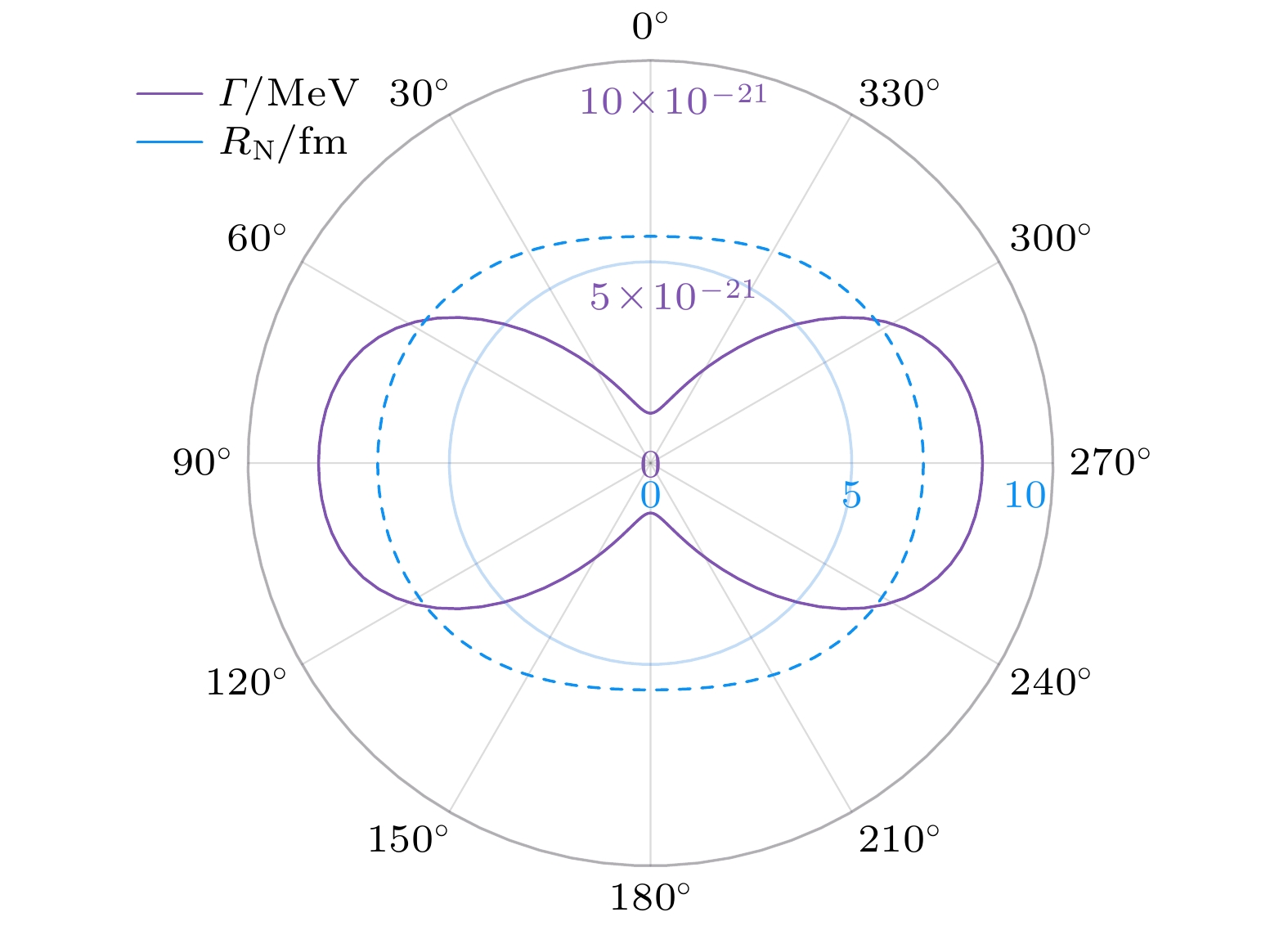
图 2 151Lu核中子核Woods-Saxon半径的形变(虚线) 与母核质子放射性衰变宽度的角分布(实线)
Fig. 2. The angular distrbution of the deformed radius (dashed line) and the decay width (solid line).
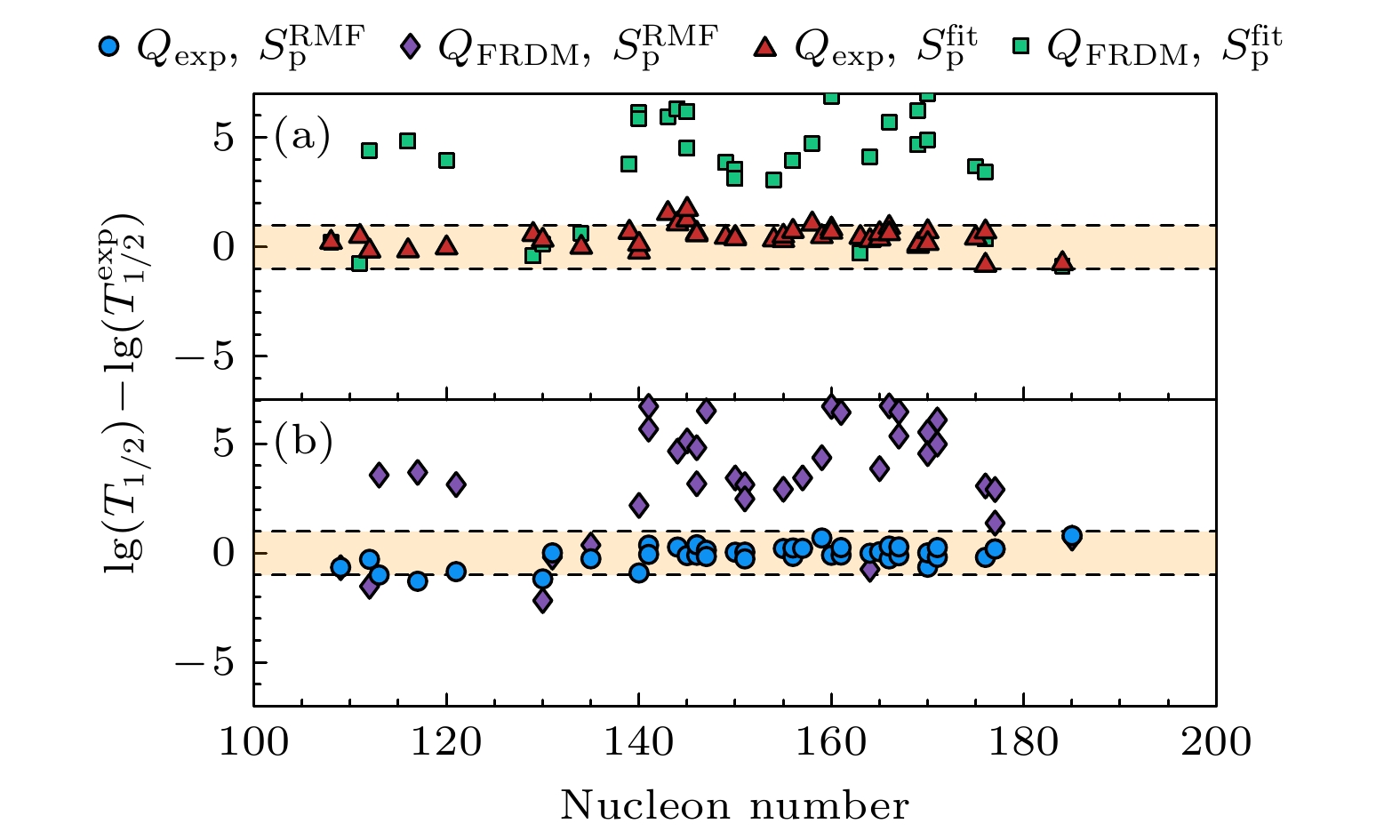
图 3 本文的理论模型在实验衰变能和FRDM衰变能参数下对半衰期的计算误差 (a) 使用拟合得到的谱因子; (b) 使用RMF理论得到的谱因子. 阴影部分代表对数下的计算值与实验值相差在1以内
Fig. 3. Errors of the theoretical model in experimental and FRDM decay energies: (a) using the spectroscopic factor by fitting; (b) using the spectroscopic factor of RMF theory. The shaded region indicates that the difference between our calculated value and the experimental value under logarithmic conditions is smaller than 1.
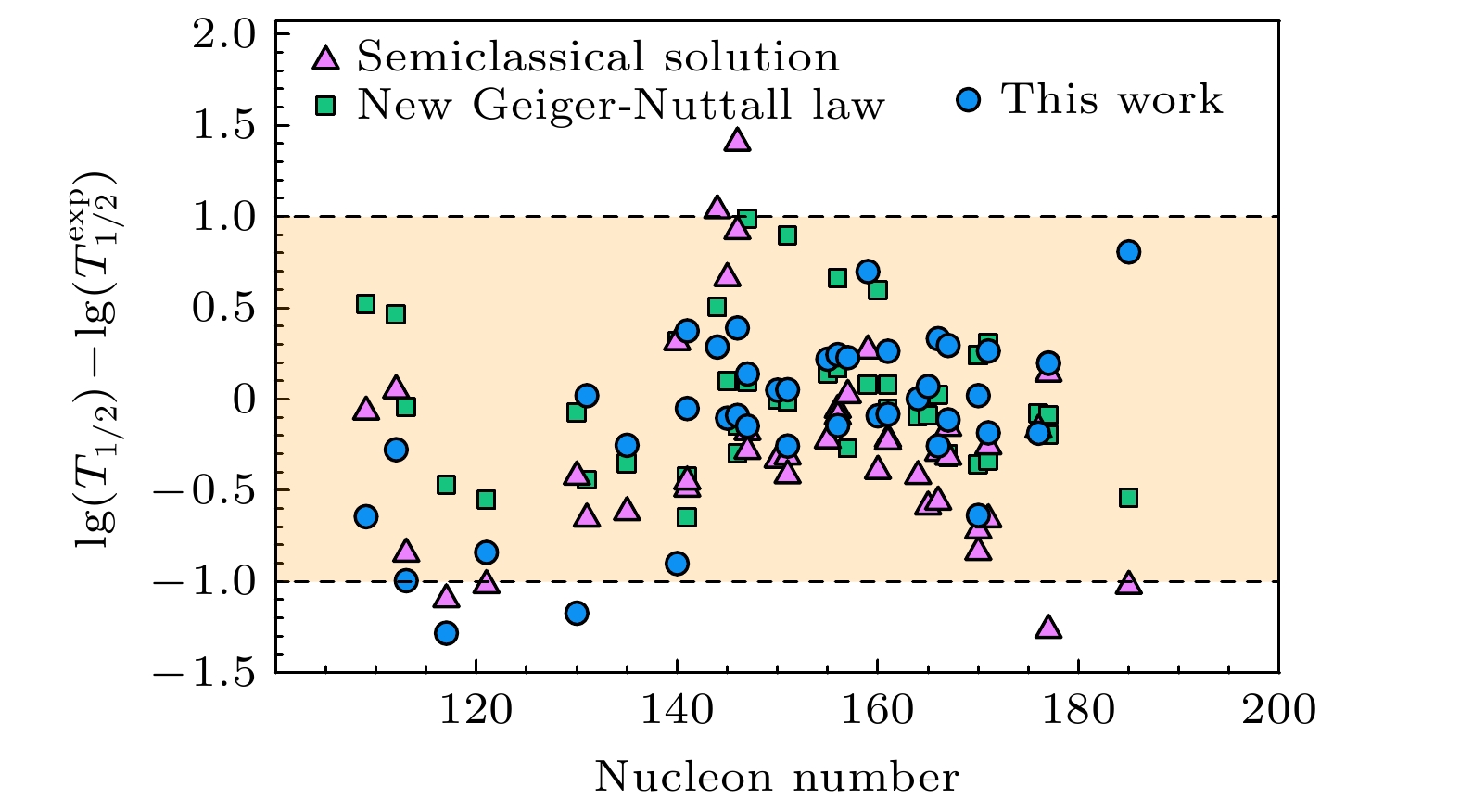
图 4 本文的计算结果和其他理论的结果(包括解析的半经典计算[11]与拓展的Geiger-Nuttall定律[44])与实验值的对比. 横轴代表母核的核子数, 纵轴代表各组半衰期计算结果与实验值的对数的差值
Fig. 4. The difference between this work and other theoretical methods (including an analytic semiclassical solution[11] and the new Geiger-Nuttall law[44]). The horizontal axis denotes the nucleon number of the parent nucleus, while the vertical axis illustrates the difference between the logarithms of the calculated and experimental half-lives.
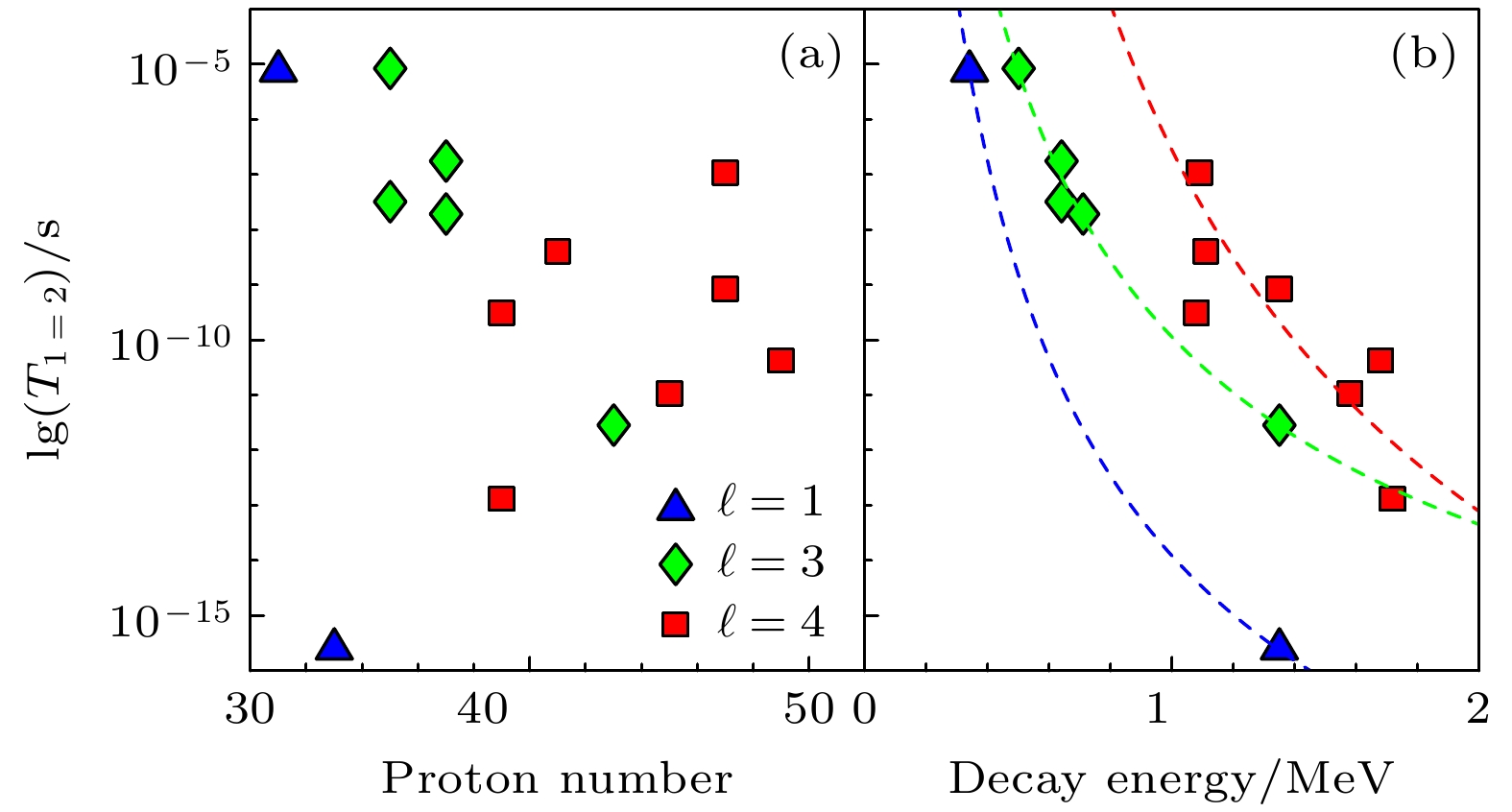
图 5 本文理论预言的质子数30到50的一系列质子放射核的半衰期, 及其与(a)母核质子数和(b)实验衰变能之间的关系, 其中与衰变能的关系符合Geiger-Nuttal定律, 如图中虚线所示
Fig. 5. The predicted half-lives for serial proton emitters in the range from $ Z = 30 $ to $ Z = 50 $ in this work, and the dependence on (a) the proton number of parent nuclei and (b) the decay energy, which is consistent to the Geiger-Nuttal law as the dashed lines.
表 1 一些质子放射核的相关实验和理论数据, 其中质子轨道为球形极限下发射质子占据的轨道, $ Q_{\rm{exp}} $和$ Q_{\rm{FRDM}} $分别为实验(除表中的特别标注外, 由NNDC和AME 2020中列出的实验值得到[3,40,41]) 和FRDM理论[39]得到的衰变能, $ \beta_{2, 4} $为形变参数, $ T_{1/2}^{\rm{exp}} $为实验半衰期以10为底的对数, 最后两列为使用RMF和形变依赖的拟合两种方法得到的谱因子
Table 1. Experimental data of various proton emitters, where the orbital is occupied in the spherical limit, $ Q_{\rm{exp}} $ and $ Q_{\rm{FRDM}} $ are the decay energy by experiments (obtained from NNDC and AME 2020 except for those specifically marked values) and FRDM theory, $ \beta_{2, 4} $ are deformation parameters, $ T_{1/2}^{\rm{exp}} $ is the experimental half-life, and the last two columns denote the spectroscopic factors calculated by RMF and deformation-dependent fitting.
母核 $ n\ell_j $ $ Q_{\rm{exp}} $/MeV $ Q_{\rm{FRDM}} $/MeV $ \beta_2 $ $ \beta_4 $ $ \log_{10}T_{1/2}^{\rm{exp}} $ $ S_p^{\rm{RMF}} $ $ S_p^{\rm{fit}} $ 109I $ 2 d_{5/2} $ 0.820 0.821 0.139 0.056 –4.029 0.726 0.099 112Cs $ 2 d_{5/2} $ 0.816 0.901 0.185 0.052 –3.310 0.369 0.063 113Cs $ 2 d_{3/2} $ 0.973 0.681 0.195 0.054 –4.752 0.373 0.057 117La $ 2 d_{3/2} $ 0.820 0.581 0.282 0.106 –1.602 0.311 0.024 121Pr $ 2 d_{3/2} $ 0.890 0.671 0.304 0.087 –2.000 0.122 0.019 130Eu $ 2 d_{3/2} $ 1.028[45] 1.111 0.331 0.018 –3.046 0.816 0.014 131Eu $ 2 d_{3/2} $ 0.947 0.961 0.331 0.018 –1.699 0.029 0.014 135Tb $ 2 f_{7/2} $ 1.188 1.131 0.322 –0.037 –3.027 0.028 0.016 140Ho $ 2 f_{7/2} $ 1.094 0.881 0.276 –0.047 –2.222 0.952 0.025 141Ho $ 2 f_{7/2} $ 1.177 0.761 0.253 –0.039 –2.387 0.008 0.032 141Hom $ 3 s_{1/2} $ 1.243 0.827 0.253 –0.039 –5.137 0.048 0.032 144Tm $ 1 h_{11/2} $ 1.712 1.201 0.254 –0.064 –5.721 0.558[43] 0.031 145Tm $ 1 h_{11/2} $ 1.736 1.141 0.231 –0.068 –5.499 0.580 0.039 146Tm $ 1 h_{11/2} $ 1.196 0.951 0.219 –0.057 –1.125 0.962 0.045 146Tmm $ 1 h_{11/2} $ 1.120 0.833 0.219 –0.057 –0.703 0.962 0.045 147Tm $ 1 h_{11/2} $ 1.059 0.661 –0.187 –0.022 0.587 0.581 0.187 147Tmm $ 2 d_{3/2} $ 1.127 0.729 –0.187 –0.022 –3.444 0.953 0.187 150Lu $ 1 h_{11/2} $ 1.270 1.001 –0.167 –0.035 –1.197 0.497 0.199 151Lu $ 1 h_{11/2} $ 1.241 1.001 –0.167 –0.035 –0.896 0.490 0.199 151Lum $ 2 d_{3/2} $ 1.319 1.079 –0.167 –0.035 –4.796 0.858 0.199 155Ta $ 1 h_{11/2} $ 1.453 1.191 0.021 0.000 –2.538 0.422 0.324 156Ta $ 2 d_{3/2} $ 1.020 0.591 –0.063 0.001 –0.842 0.761 0.274 156Tam $ 1 h_{11/2} $ 1.122 0.693 –0.063 0.001 0.933 0.493 0.274 157Ta $ 3 s_{1/2} $ 0.935 0.771 –0.084 0.014 –0.527 0.797 0.257 159Rem $ 1 h_{11/2} $ 1.720 1.301 0.085 0.003 –4.665 0.387[43] 0.171 160Re $ 2 d_{3/2} $ 1.267 0.821 0.107 0.004 –3.045 0.507 0.137 161Re $ 3 s_{1/2} $ 1.197 0.761 0.128 0.018 –3.357 0.892 0.111 161Rem $ 1 h_{11/2} $ 1.321 0.885 0.128 0.018 –0.678 0.290 0.111 164Irm $ 1 h_{11/2} $ 1.814 1.928 0.118 –0.007 –4.155 0.339[43] 0.123 165Irm $ 1 h_{11/2} $ 1.740 1.311 0.129 0.006 –3.462 0.187 0.110 166Ir $ 2 d_{3/2} $ 1.152 0.711 0.140 –0.005 –0.824 0.415 0.098 166Irm $ 1 h_{11/2} $ 1.324 0.883 0.140 –0.005 –0.076 0.188 0.098 167Ir $ 3 s_{1/2} $ 1.070 0.731 0.151 –0.004 –1.028 0.912 0.088 167Irm $ 1 h_{11/2} $ 1.245 0.906 0.151 –0.004 0.848 0.183 0.088 170Au $ 2 d_{3/2} $ 1.472 0.981 0.129 0.007 –3.493 0.511 0.110 170Aum $ 1 h_{11/2} $ 1.757 1.266 0.129 0.007 –2.973 0.137[43] 0.110 171Au $ 3 s_{1/2} $ 1.448 0.961 0.129 –0.006 –4.770 0.848 0.110 171Aum $ 1 h_{11/2} $ 1.707 1.220 0.129 –0.006 –2.654 0.087 0.110 176Tl $ 3 s_{1/2} $ 1.265 1.031 –0.115 –0.03 –2.284 0.926 0.233 177Tl $ 3 s_{1/2} $ 1.156 0.981 –0.115 –0.03 –1.176 0.733 0.233 177Tlm $ 1 h_{11/2} $ 1.963 1.788 –0.115 –0.03 –3.346 0.022 0.233 185Bi $ 3 s_{1/2} $ 1.598[46] 1.611 0.000 0.012 –4.191 0.011 0.400  下载: 导出CSV
表 2 本文的理论模型对一些质子放射核的半衰期的计算值, 使用表 1中的两组谱因子和衰变能. 第二、三列半衰期使用实验衰变能[3,40,41], 第四、五列的半衰期使用由FRDM理论[39]得到的衰变能$ Q_{\rm{FRDM}} $计算, 最后两列展示了其他理论计算得到的结果
Table 2. Data calculated by our theoretical model, using different spectroscopic factors and decay energies in Table 1. The second and third columns correspond to the experimental decay energy[3,40,41], while the fourth and fifth columns correspond to the decay energy obtained by FRDM[39] as $ Q_{\rm{FRDM}} $. The last two columns are the results of other theoretical works.
母核 基于实验衰变能 基于FRDM衰变能 其他理论研究结果 $ \log_{10}T_{1/2}^{\rm{RMF}} $ $ \log_{10}T_{1/2}^{\rm{fit}} $ $ \log_{10}T_{1/2}^{\rm{RMF}} $ $ \log_{10}T_{1/2}^{\rm{fit}} $ Ref. [11] Ref. [44] 109I –4.673 –3.809 –4.688 –3.824 –4.098 –3.507 112Cs –3.587 –2.816 –4.823 –4.053 –3.261 –2.844 113Cs –5.746 –4.928 –1.171 –0.353 –5.599 –4.796 117La –2.884 –1.765 2.101 3.219 –2.699 –2.072 121Pr –2.840 –2.032 1.147 1.955 –3.020 –2.552 130Eu –4.218 –2.468 –5.211 –3.461 –3.470 –3.121 131Eu –1.680 –1.379 –1.876 –1.575 –2.354 –2.141 135Tb –3.279 –3.033 –2.652 –2.405 –3.647 –3.380 140Ho –3.123 –1.545 –0.031 1.547 –1.909 –1.902 141Ho –2.013 –2.611 4.341 3.743 –2.878 –2.811 141Hom –5.188 –5.007 0.549 0.729 –5.588 –5.783 144Tm –5.435 –4.185 –1.044 0.206 –4.686 –5.216 145Tm –5.603 –4.436 –0.355 0.812 –4.835 –5.401 146Tm –1.214 0.120 2.058 3.393 –0.204 –1.272 146Tmm –0.313 1.022 4.129 5.463 0.702 –0.999 147Tm 0.725 1.218 8.322 8.814 0.408 0.681 147Tmm –3.591 –2.884 3.079 3.786 –3.728 –2.455 150Lu –1.148 –0.750 2.250 2.647 –1.530 –1.199 151Lu –0.844 –0.452 2.248 2.639 –1.211 –0.911 151Lum –5.053 –4.418 –2.304 –1.669 –5.213 –3.899 155Ta –2.318 –2.204 1.191 0.509 –2.764 –2.397 156Ta –0.986 –0.542 8.836 9.280 –0.901 –0.180 156Tam 1.177 1.433 9.178 9.434 0.839 1.101 157Ta –0.299 0.193 2.923 3.416 –0.505 –0.797 159Rem –3.966 –3.610 –0.290 0.066 –4.399 –4.586 160Re –3.136 –2.568 3.681 4.250 –3.438 –2.450 161Re –3.439 –2.533 3.901 4.807 –3.575 –3.277 161Rem –0.415 0.003 5.771 6.189 –0.910 –0.729 164Irm –4.152 –3.711 –4.890 –4.448 –4.577 –4.247 165Irm –3.392 –3.161 0.413 0.645 –4.051 –3.550 166Ir –1.080 –0.454 7.189 7.814 –1.386 –0.801 166Irm 0.255 0.537 6.672 6.953 –0.370 –0.344 167Ir –1.142 –0.126 5.450 6.465 –1.186 –1.347 167Irm 1.142 1.460 6.213 6.530 0.532 0.546 170Au –4.130 –3.462 2.053 2.720 –4.331 –3.254 170Aum –2.954 –2.857 1.592 1.688 –3.693 –3.330 171Au –4.954 –4.066 1.332 2.220 –5.028 –4.460 171Aum –2.390 –2.491 2.344 2.243 –3.313 –2.992 176Tl –2.470 –1.871 0.799 1.397 –2.451 –2.361 177Tl –0.978 –0.481 1.742 2.239 –1.035 –1.263 177Tlm –3.149 –4.174 –1.962 –2.988 –4.611 –3.543 185Bi –3.383 –4.944 –3.495 –5.055 –5.214 –4.730
下载: 导出CSV
表 3 对fpg壳层中可能的质子放射核的半衰期的理论预言. 其中衰变能Q根据NNDC数据库和AME 2020质量表中的单质子分离能实验值计算得到[3,40,41] (#上标表示该数值为AME 2020中的评价值), 形变参数$ \beta_{2, 4} $和谱因子$ S_p^{\rm{RHB}} $则分别由FRDM[39]和RHB[48]的计算结果得到. 最后一列为本文预言的质子放射性半衰期(以秒为单位) 的对数
Table 3. The theoretical prediction on the half-lives of fpg-shell possible proton emitters. The decay energy Q is taken from the proton separation energy in NNDC and AME 2020[3,40,41] (the superscript # denotes values that are not obtained from purely experimental data in AME 2020), and the deformation parameters $ \beta_{2, 4} $ and spectroscopic factor $ S_p^{\rm{RHB}} $ are obtained by the results of FRDM[39] and RHB[48], respectively. The predicted half-lives using our model are listed in the last column.
母核 质子轨道 Q / MeV $ \beta_2 $ $ \beta_4 $ $ S_p^{\rm{RHB}} $ $ \log_{10}T_{1/2}^{\rm{pred}} $ 60Ga $ 2 p_{3/2} $ 0.340# 0.106 0.041 0.53 –5.140 63As $ 2 p_{3/2} $ 1.350# 0.184 0.014 0.61 –15.627 68Br $ 1 f_{5/2} $ 0.500# 0.220 –0.082 0.80 –5.071 69Br $ 1 f_{5/2} $ 0.640 0.233 –0.106 0.78 –7.489 72Rb $ 1 f_{5/2} $ 0.710# –0.357 0.022 0.83 –7.713 73Rb $ 1 f_{5/2} $ 0.640 –0.366 0.025 0.83 –6.751 75Y $ 1 g_{9/2} $ 1.720# 0.401 0.001 0.92 –12.882 76Y $ 1 g_{9/2} $ 1.080# 0.402 –0.012 0.84 –9.505 81Nb $ 1 g_{9/2} $ 1.110# 0.430 –0.047 0.12 –8.391 84Tc $ 1 f_{5/2} $ 1.350# 0.492 –0.021 0.90 –11.544 88Rh $ 1 g_{9/2} $ 1.580# –0.243 –0.101 0.73 –10.976 92Ag $ 1 g_{9/2} $ 1.350# –0.011 0.000 0.56 –9.074 93Ag $ 1 g_{9/2} $ 1.090# 0.000 0.000 0.39 –6.967 96In $ 1 g_{9/2} $ 1.680# 0.053 0.001 0.49 –10.374 97In $ 1 g_{9/2} $ 0.890# –0.021 0.000 0.19 –3.965
下载: 导出CSV
-
[1] 任中洲, 徐躬耦 1991 40 1229
 Google Scholar
Ren Z Z, Xu G O 1991 Acta Phys. Sin. 40 1229
Google Scholar
[2] 丁斌刚, 鲁定辉, 张大立 2007 56 6905
Google Scholar
Ding B G, Lu D H, Zhang D L 2007 Acta Phys. Sin. 56 6905
Google Scholar
[3] National Nuclear Data Center, https://www.nndc.bnl.gov
[4] Sarmiento L G, Roger T, Giovinazzo J, Brown B A, Blank B, Rudolph D, Kankainen A, Alvarez-Pol H, Raj A A, Ascher P, Block M, Caamaño-Fresco M, Caceres L, Canete L, Cox D M, Eronen T, Fahlander C, Fernández-Domínguez B, Forsberg U, Lois-Fuentes J, Gerbaux M, Gerl J, Golubev P, Grévy S, Grinyer G F, Habermann T, Hakala J, Jokinen A, Kamalou O, Kojouharov I, Kolhinen V S, Koponen J, Kurz N, Lalović N, Lorenz C, Mauss B, Mentana A, Moore I D, Ortega Moral A, Pancin J, Papadakis P, Pibernat J, Piot J, Pohjalainen I, Reinikainen J, Rinta-Antila S, Schaffner H, Sorlin O, Stodel C, Thomas J C, Versteegen M, Voss A 2023 Nat. Commun. 14 5961
Google Scholar
[5] Giovinazzo J, Roger T, Blank B, Rudolph D, Brown B A, Alvarez-Pol H, Arokia Raj A, Ascher P, Caamaño-Fresco M, Caceres L, Cox D M, Fernández-Domínguez B, Lois-Fuentes J, Gerbaux M, Grévy S, Grinyer G F, Kamalou O, Mauss B, Mentana A, Pancin J, Pibernat J, Piot J, Sorlin O, Stodel C, Thomas J C, Versteegen M 2021 Nat. Commun. 12 4805
Google Scholar
[6] Ye Y L, Yang X F, Sakurai H, Hu B S 2024 Nat. Rev. Phys. 7 21
Google Scholar
[7] Karny M, Rykaczewski K, Grzywacz R K, Batchelder J C, Bingham C R, Goodin C, Gross C J, Hamilton J H, Korgul A, Królas W, Liddick S N, Li K, Maier K H, Mazzocchi C, Piechaczek A, Rykaczewski K, Schapira D, Simpson D, Tantawy M N, Winger J A, Yu C H, Zganjar E F, Nikolov N, Dobaczewski J, Kruppa A T, Nazarewicz W, Stoitsov M V 2008 Phys. Lett. B 664 52
Google Scholar
[8] Zhang W, Cederwall B, Aktas O, Liu X, Ertoprak A, Nyberg A, Auranen K, Alayed B, Badran H, Boston H, Doncel M, Forsberg U, Grahn T, Greenlees P T, Guo S, Heery J, Hilton J, Jenkins D, Julin R, Juutinen S, Luoma M, Neuvonen O, Ojala J, Page R D, Pakarinen J, Partanen J, Paul E S, Petrache C, Rahkila P, Ruotsalainen P, Sandzelius M, Sarén J, Szwec S, Tann H, Uusitalo J, Wadsworth R 2022 Commun. Phys. 5 285
Google Scholar
[9] Auranen K, Seweryniak D, Albers M, Ayangeakaa A D, Bottoni S, Carpenter M, Chiara C J, Copp P, David H M, Doherty D T, Harker J, Hoffman C R, Janssens R V F, Khoo T L, Kuvin S A, Lauritsen T, Lotay G, Rogers A M, Scholey C, Sethi J, Talwar R, Walters W B, Woods P J, Zhu S 2019 Phys. Lett. B 792 187
Google Scholar
[10] Jackson K P, Cardinal C U, Evans H C, Jelley N A, Cerny J 1970 Phys. Lett. B 33 281
[11] Delion D S, Dumitrescu A 2021 Phys. Rev. C 103 054325
Google Scholar
[12] Ni D D, Ren Z Z 2015 Annals Phys. 358 108
Google Scholar
[13] Zhang D M, Qi L J, Gui H F, Luo S, He B, Wu X J, Li X H 2023 Phys. Rev. C 108 024318
Google Scholar
[14] Qian Y B, Ren Z Z 2016 Eur. Phys. J. A 52 68
Google Scholar
[15] Cheng J H, Pan X, Zou Y T, Li X H, Zhang Z, Chu P C 2020 Eur. Phys. J. A 56 273
Google Scholar
[16] Routray T R, Mishra A, Tripathy S K, Behera B, Basu D N 2012 Eur. Phys. J. A 48 77
Google Scholar
[17] Esbensen H, Davids C N 2000 Phys. Rev. C 63 014315
Google Scholar
[18] Ferreira L S, Maglione E, Ring P 2011 Phys. Lett. B 701 508
Google Scholar
[19] Tsunoda N, Otsuka T, Takayanagi K, Shimizu N, Suzuki T, Utsuno Y, Yoshida S, Ueno H 2020 Nature 587 66
Google Scholar
[20] Jain A, Parab P, Saxena G, Aggarwal M 2024 Sci. Rep. 14 28368
Google Scholar
[21] Wang Z, Bai D, Ren Z Z 2022 Phys. Rev. C 105 024327
Google Scholar
[22] Wang Z, Ren Z Z 2022 Phys. Rev. C 106 024311
[23] 邢凤竹, 乐先凯, 王楠, 王艳召 2025 74 112301
Google Scholar
Xing F Z, Le X K, Wang N, Wang Y Z 2025 Acta Phys. Sin. 74 112301
Google Scholar
[24] Wang Z, Ren Z Z 2023 Phys. Rev. C 108 024306
[25] 圣宗强, 舒良萍, 孟影, 胡继刚, 钱建发 2014 63 162302
Google Scholar
Sheng Z Q, Shu L P, Meng Y, Hu J G, Qian J F 2014 Acta Phys. Sin. 63 162302
Google Scholar
[26] 邢凤竹, 崔建坡, 王艳召, 顾建中 2022 71 062301
Google Scholar
Xing F Z, Cui J P, Wang Y Z, Gu J Z 2022 Acta Phys. Sin. 71 062301
Google Scholar
[27] Delion D S, Ghinescu S 2025 J. Phys. G: Nucl. Part. Phys. 52 055105
Google Scholar
[28] Maglione E, Ferreira L S, Liotta R J 1998 Phys. Rev. Lett. 81 538
Google Scholar
[29] Buck B, Merchant A C, Perez S M 1992 Phys. Rev. C 45 1688
[30] Talou P, Strottman D, Carjan N 1999 Phys. Rev. C 60 054318
Google Scholar
[31] Bhagwat A, Viñas X, Centelles M, Schuck P, Wyss R 2010 Phys. Rev. C 81 044321
Google Scholar
[32] Wu Z Y, Qi C, Wyss R, Liu H L 2015 Phys. Rev. C 92 024306
[33] Bykhalo G I, Orlin V N, Stopani K A arXiv: 2107.08245[nucl-th]
[34] Sheng Z Q, Fan G W, Qian J F, Hu J G 2015 Eur. Phys. J. A 51 40
Google Scholar
[35] Delion D S 2010 Theory of particle and cluster emission (Springer
[36] Åberg S, Semmes P B, Nazarewicz W 1997 Phys. Rev. C 56 1762
[37] Delion D S, Liotta R J, Wyss R 2006 Phys. Rep. 424 113
Google Scholar
[38] Kondev F G, Wang M, Huang W J, Naimi S, Audi G 2021 Chin. Phys. C 45 030001
Google Scholar
[39] Möller P, Sierk A J, Ichikawa T, Sagawa H 2016 Atom. Data Nucl. Data Tables 109-110 1
Google Scholar
[40] Huang W J, Wang M, Kondev F G, Audi G, Naimi S 2021 Chin. Phys. C 45 030002
Google Scholar
[41] Wang M, Huang W J, Kondev F G, Audi G, Naimi S 2021 Chin. Phys. C 45 030003
Google Scholar
[42] Zhang H F, Wang Y J, Dong J M, Li J Q, Scheid W 2010 J. Phys. G: Nucl. Part. Phys. 37 085107
Google Scholar
[43] Soylu A, Koyuncu F, Gangopadhyay G, Dehghani V, Alavi S A 2021 Chin. Phys. C 45 044108
Google Scholar
[44] Chen J L, Xu J Y, Deng J G, Li X H, He B, Chu P C 2019 Eur. Phys. J. A 55 214
Google Scholar
[45] Davids C N, Woods P J, Mahmud H, Davinson T, Heinz A, Ressler J J, Schmidt K, Seweryniak D, Shergur J, Sonzogni A A, Walters W B 2004 Phys. Rev. C 69 011302
Google Scholar
[46] Poli G L, Davids C N, Woods P J, Seweryniak D, Carpenter M P, Cizewski J A, Davinson T, Heinz A, Janssens R V F, Lister C J, Ressler J J, Sonzogni A A, Uusitalo J, Walters W B 2001 Phys. Rev. C 63 044304
[47] Čeliković I, Lewitowicz M, Gernhäuser R, Krücken R, Nishimura S, Sakurai H, Ahn D S, Baba H, Blank B, Blazhev A, Boutachkov P, Browne F, de France G, Doornenbal P, Faestermann T, Fang Y, Fukuda N, Giovinazzo J, Goel N, Górska M, Ilieva S, Inabe N, Isobe T, Jungclaus A, Kameda D, Kim Y K, Kwon Y K, Kojouharov I, Kubo T, Kurz N, Lorusso G, Lubos D, Moschner K, Murai D, Nishizuka I, Park J, Patel Z, Rajabali M, Rice S, Schaffner H, Shimizu Y, Sinclair L, Söderström P A, Steiger K, Sumikama T, Suzuki H, Takeda H, Wang Z, Watanabe H, Wu J, Xu Z 2016 Phys. Rev. Lett. 116 162501
Google Scholar
[48] Lalazissis G A, Vretenar D, Ring P 2001 Nucl. Phys. A 679 481
Google Scholar
[49] Xu X D, Mukha I, Grigorenko L V, Scheidenberger C, Acosta L, Casarejos E, Chudoba V, Ciemny A A, Dominik W, Duénas-Díaz J, Dunin V, Espino J M, Estradé A, Farinon F, Fomichev A, Geissel H, Golubkova T A, Gorshkov A, Janas Z, Kamiński G, Kiselev O, Knöbel R, Krupko S, Kuich M, Litvinov Y A, Marquinez-Durán G, Martel I, Mazzocchi C, Nociforo C, Ordúz A K, Pfützner M, Pietri S, Pomorski M, Prochazka A, Rymzhanova S, Sánchez-Benítez A M, Sharov P, Simon H, Sitar B, Slepnev R, Stanoiu M, Strmen P, Szarka I, Takechi M, Tanaka Y K, Weick H, Winkler M, Winfield J S 2018 Phys. Rev. C 97 034305
Google Scholar
[50] Xu X D, Mukha I, Li J G, Wang S M, Acosta L, Bajzek M, Casarejos E, Cortina-Gil D, Espino J M, Fomichev A, Geissel H, Gómez-Camacho J, Grigorenko L V, Kiselev O, Korsheninnikov A A, Kostyleva D, Kurz N, Litvinov Y A, Martel I, Nociforo C, Pfützner M, Rodríguez-Tajes C, Scheidenberger C, Stanoiu M, Sümmerer K, Weick H, Woods P J, Zhukov M V 2025 Phys. Rev. Lett. 135 022502
Google Scholar


 下载:
下载:
计量
- 文章访问数: 295
- PDF下载量: 4
- 被引次数: 0
